
GCSE Chemistry (AQA)
196 videos | 19 hours
Please subscribe to watch this video.
This, and all other videos, are included in our premium subscriptions.
Premium accounts get access to all videos.
Enable autoplay to keep watching
Your browser is blocking videos from playing automatically. To turn it back on:
Safari (Mac): Click the Safari menu item in the top bar, then Settings → Websites → Auto-Play, then set Auto-Play to Allow All Auto-Play for the current website.
Safari (iPhone/iPad): open the Settings app, then Apps → Safari → Auto-Play, and select Allow All Auto-Play.
Metal Hydroxide Test
- Sodium hydroxide solution can identify positive metal ions.
- This test is important for exams.
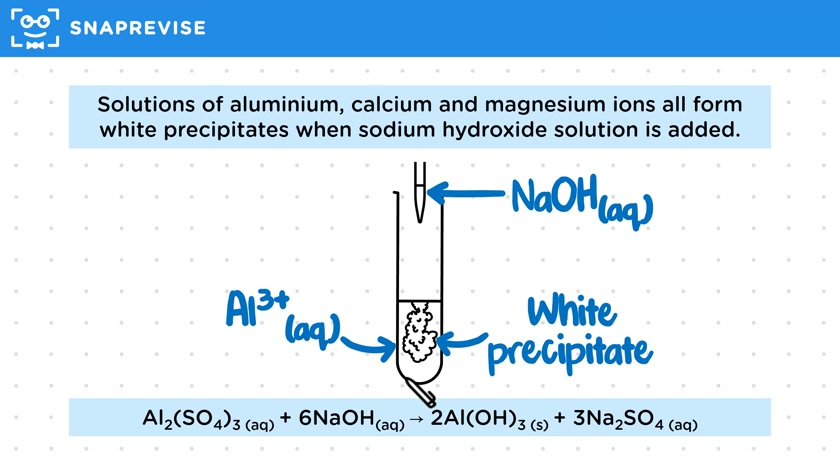
- Sodium hydroxide (NaOH) is added drop by drop to an unknown solution.
- A precipitate forms if certain metal ions are present.
- Aluminum, calcium, and magnesium ions form white precipitates with NaOH.
- Calcium ions form calcium hydroxide, a white precipitate.
- Balanced equation for calcium: CaSO4 + 2NaOH ��� Ca(OH)2 + Na2SO4.
- Magnesium ions also form a white precipitate.
- Balanced equation for magnesium: MgSO4 + 2NaOH ��� Mg(OH)2 + Na2SO4.
- Aluminum ions form a white precipitate that dissolves with excess NaOH.
- Balanced equation for aluminum: Al2(SO4)3 + 6NaOH ��� 2Al(OH)3 + 3Na2SO4.
- Calcium and magnesium hydroxide precipitates do not dissolve with excess NaOH.
- Copper(II) ions form a blue precipitate with NaOH.
- Balanced equation for copper: CuSO4 + 2NaOH ��� Cu(OH)2 + Na2SO4.
- Iron(II) ions form a green precipitate with NaOH.
- Balanced equation for iron(II): FeSO4 + 2NaOH ��� Fe(OH)2 + Na2SO4.
- Iron(III) ions form a brown precipitate with NaOH.
- Balanced equation for iron(III): Fe2(SO4)3 + 6NaOH ��� 2Fe(OH)3 + 3Na2SO4.
- Aluminum hydroxide dissolves with excess NaOH, distinguishing it from calcium and magnesium.
Please subscribe to access these revision notes.
This, and all other video notes, are included in our premium subscriptions.
Premium accounts get access to all videos and revision notes.
30
questions for Chemical analysis
9
questions for Identification of ions by chemical and spectroscopic means (chemistry only)