
GCSE Chemistry (AQA)
196 videos | 19 hours
Please subscribe to watch this video.
This, and all other videos, are included in our premium subscriptions.
Premium accounts get access to all videos.
Enable autoplay to keep watching
Your browser is blocking videos from playing automatically. To turn it back on:
Safari (Mac): Click the Safari menu item in the top bar, then Settings → Websites → Auto-Play, then set Auto-Play to Allow All Auto-Play for the current website.
Safari (iPhone/iPad): open the Settings app, then Apps → Safari → Auto-Play, and select Allow All Auto-Play.
Moles
- Masses of individual atoms and molecules are too small for practical calculations.
- A single carbon atom's mass is 1.99 x 10^-23 grams, requiring 26 decimal places.
- Chemistry uses moles to measure chemical amounts for easier calculations.
- Moles can quantify atoms, molecules, ions, and electrons, used in formulae and equations.
- The mass of one mole of a substance in grams equals its relative formula mass.
- Example: Carbon dioxide (CO2) has a relative formula mass of 44, so one mole weighs 44 grams.
- The symbol for the unit mole is MOL.
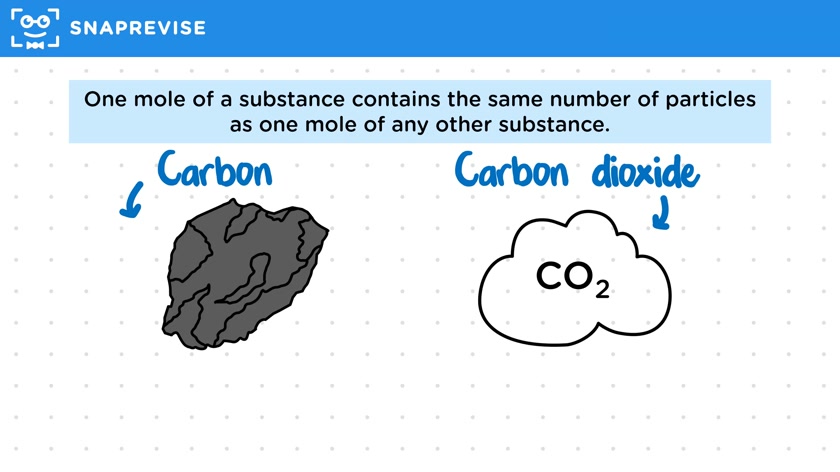
- One mole of a substance contains the same number of particles as one mole of any other substance.
- Example: One mole of carbon (12 grams) and one mole of CO2 (44 grams) contain the same number of particles.
- The number of particles in a mole is known as the Avogadro constant, 6.02 x 10^23.
- Avogadro constant applies to atoms, molecules, or ions, regardless of the substance.
- Understanding moles and the Avogadro constant is crucial for exams.
Please subscribe to access these revision notes.
This, and all other video notes, are included in our premium subscriptions.
Premium accounts get access to all videos and revision notes.
19
questions for Quantitative chemistry
13
questions for Use of amount of substance in relation to masses of pure substances