
GCSE Chemistry (AQA)
196 videos | 19 hours
Please subscribe to watch this video.
This, and all other videos, are included in our premium subscriptions.
Premium accounts get access to all videos.
Enable autoplay to keep watching
Your browser is blocking videos from playing automatically. To turn it back on:
Safari (Mac): Click the Safari menu item in the top bar, then Settings → Websites → Auto-Play, then set Auto-Play to Allow All Auto-Play for the current website.
Safari (iPhone/iPad): open the Settings app, then Apps → Safari → Auto-Play, and select Allow All Auto-Play.
Paper Chromatography
- Chromatography is a technique to separate mixtures.
- It uses chromatography paper in a lab setting.
- A pencil line is drawn 2 cm from the bottom of the paper.
- A dot of the mixture is placed on the pencil line.
- The paper is placed in a beaker with a solvent, avoiding submerging the pencil line.
- The solvent moves through the paper, carrying substances with it.
- This process is known as paper chromatography.
- Other types of chromatography include gas chromatography.
- For exams, focus on paper chromatography and its process.
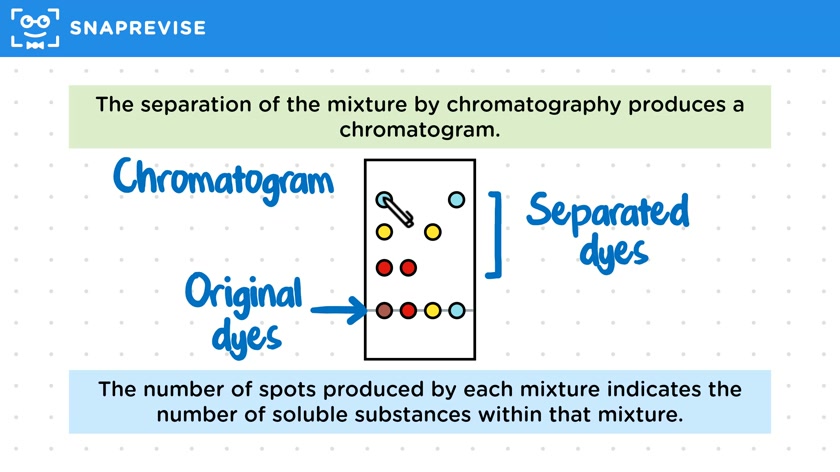
- Chromatography produces a chromatogram.
- Chromatograms show the separation of mixtures into different spots.
- The number of spots indicates the number of soluble substances.
- Pure substances result in one spot; impure substances result in multiple spots.
- Chromatograms can distinguish between pure and impure substances.
- Chromatograms can identify substances by comparing them with known substances.
- Substances are likely the same if they travel the same distance and have a similar color.
- Example: A brown dye separated into red, yellow, and blue dyes, indicating it was a mixture.
- For exams, interpret and analyze chromatograms.
Please subscribe to access these revision notes.
This, and all other video notes, are included in our premium subscriptions.
Premium accounts get access to all videos and revision notes.
30
questions for Chemical analysis
17
questions for Purity, formulations and chromatography