
GCSE Chemistry (AQA)
196 videos | 19 hours
Please subscribe to watch this video.
This, and all other videos, are included in our premium subscriptions.
Premium accounts get access to all videos.
Enable autoplay to keep watching
Your browser is blocking videos from playing automatically. To turn it back on:
Safari (Mac): Click the Safari menu item in the top bar, then Settings → Websites → Auto-Play, then set Auto-Play to Allow All Auto-Play for the current website.
Safari (iPhone/iPad): open the Settings app, then Apps → Safari → Auto-Play, and select Allow All Auto-Play.
Polymers & Covalent Bonds
- Many substances are made of polymers.
- Polymers consist of very large molecules and are prevalent in everyday life.
- Plastic shopping bags are made from a polymer called polyethylene.
- Polymers can be thousands of atoms long.
- Most polymers are composed of carbon and hydrogen atoms forming long chains.
- Polyethylene is made entirely of carbon and hydrogen atoms in a long chain.
- Atoms in a polymer molecule are connected by strong covalent bonds.
- There are strong covalent bonds within each polymer chain.
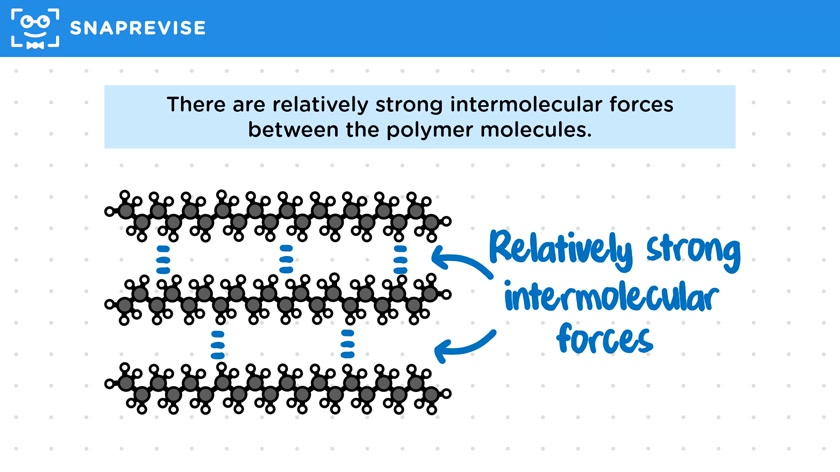
- There are relatively strong intermolecular forces between polymer molecules.
- These intermolecular forces contribute to polymers being solid at room temperature.
- A large amount of energy is required to overcome these intermolecular forces.
- Polymers like plastic water bottles have high melting points due to strong intermolecular forces.
- This is different from the weak intermolecular forces in small molecules like hydrogen and carbon dioxide.
- A repeating unit diagram can represent a polymer.
- The repeating unit is shown in brackets with the letter N indicating it repeats many times.
- More details on polymers are covered elsewhere in the course.
Please subscribe to access these revision notes.
This, and all other video notes, are included in our premium subscriptions.
Premium accounts get access to all videos and revision notes.
40
questions for Bonding, structure, and the properties of matter
11
questions for How bonding and structure are related to the properties of substances