
GCSE Chemistry (AQA)
196 videos | 19 hours
Please subscribe to watch this video.
This, and all other videos, are included in our premium subscriptions.
Premium accounts get access to all videos.
Enable autoplay to keep watching
Your browser is blocking videos from playing automatically. To turn it back on:
Safari (Mac): Click the Safari menu item in the top bar, then Settings → Websites → Auto-Play, then set Auto-Play to Allow All Auto-Play for the current website.
Safari (iPhone/iPad): open the Settings app, then Apps → Safari → Auto-Play, and select Allow All Auto-Play.
Process of Electrolysis
- Ionic compounds, when melted or dissolved in water, have free-moving ions.
- Ionic compounds consist of positively and negatively charged ions.
- Example: Molten zinc chloride (ZnCl2) has zinc ions (Zn2+) and chloride ions (Cl-).
- In liquid form, ions are not joined and move independently.
- In solutions, such as table salt (NaCl) dissolved in water, ions also separate and move freely.
- These liquids and solutions can conduct electricity and are called electrolytes.
- Pure water does not conduct electricity; it needs dissolved ions to become an electrolyte.
- Electrolysis is a process that uses electricity to split up an electrolyte.
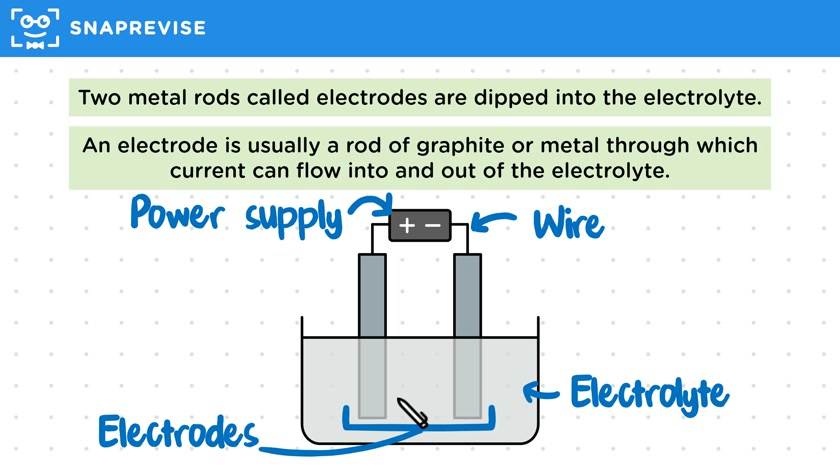
- Electrodes (metal rods) are dipped into the electrolyte to form a complete circuit.
- Electrodes are usually made of graphite or metal and are inert (non-reactive).
- The positive electrode is called the anode, and the negative electrode is called the cathode.
- The acronym PANIC helps remember: Positive Anode, Negative Is Cathode.
- When the power supply is turned on, positive ions move to the cathode, and negative ions move to the anode.
- At the anode, negative ions lose electrons to become neutral, forming elements like chlorine gas.
- At the cathode, positive ions gain electrons to become neutral, forming elements like solid zinc.
- The electrolysis process separates elements from ionic compounds.
Please subscribe to access these revision notes.
This, and all other video notes, are included in our premium subscriptions.
Premium accounts get access to all videos and revision notes.
80
questions for Chemical changes
21
questions for Electrolysis