
GCSE Chemistry (AQA)
196 videos | 19 hours
Please subscribe to watch this video.
This, and all other videos, are included in our premium subscriptions.
Premium accounts get access to all videos.
Enable autoplay to keep watching
Your browser is blocking videos from playing automatically. To turn it back on:
Safari (Mac): Click the Safari menu item in the top bar, then Settings → Websites → Auto-Play, then set Auto-Play to Allow All Auto-Play for the current website.
Safari (iPhone/iPad): open the Settings app, then Apps → Safari → Auto-Play, and select Allow All Auto-Play.
Properties of Hydrocarbons
- Crude oil fractions are separated by the size of hydrocarbon molecules.
- Hydrocarbons consist of carbon atoms bonded to hydrogens.
- Fractional distillation is used to separate hydrocarbons in crude oil into groups called fractions.
- Each fraction contains hydrocarbon chains of similar length.
- First fraction: molecules with one or two carbon atoms; last fraction: molecules with eight or more carbons.
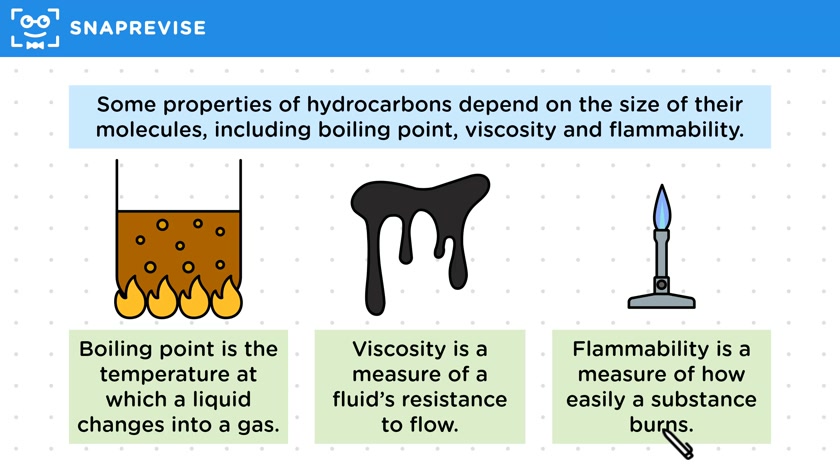
- Properties of hydrocarbons depend on molecule size: boiling point, viscosity, and flammability.
- Boiling point: temperature at which a liquid becomes a gas, important for fractional distillation.
- Viscosity: measure of a fluid's resistance to flow; thicker fluids flow slower.
- Flammability: measure of how easily a substance burns, crucial for fuels.
- As hydrocarbon molecule size increases, boiling point and viscosity increase, while flammability decreases.
- Larger hydrocarbon chains are more difficult to burn.
- Knowledge of these properties is important for exams.
- Properties determine hydrocarbon use, especially as fuels.
- Smaller hydrocarbons are more useful as fuels due to high flammability and low viscosity.
- Small liquid hydrocarbons run smoothly through engines without causing damage.
Please subscribe to access these revision notes.
This, and all other video notes, are included in our premium subscriptions.
Premium accounts get access to all videos and revision notes.
83
questions for Organic chemistry
31
questions for Carbon compounds as fuels and feedstock