
GCSE Chemistry (AQA)
196 videos | 19 hours
Please subscribe to watch this video.
This, and all other videos, are included in our premium subscriptions.
Premium accounts get access to all videos.
Enable autoplay to keep watching
Your browser is blocking videos from playing automatically. To turn it back on:
Safari (Mac): Click the Safari menu item in the top bar, then Settings → Websites → Auto-Play, then set Auto-Play to Allow All Auto-Play for the current website.
Safari (iPhone/iPad): open the Settings app, then Apps → Safari → Auto-Play, and select Allow All Auto-Play.
Reacting Metals with Water and Acids
- Metals react with water to form a metal hydroxide and hydrogen gas.
- Example: Magnesium metal added to water produces bubbles of hydrogen gas.
- More reactive metals have more vigorous reactions.
- Reactions of metals with water can be used to place them in the reactivity series.
- Potassium reacts vigorously with a lilac flame, placing it at the top of the reactivity series.
- Copper does not react with water, placing it at the bottom of the series.
- Metals become less reactive as you go down the reactivity series.
- Zinc and iron usually have no reaction with water, making it difficult to differentiate between them.
- Reactions with dilute acids can also determine metal reactivity.
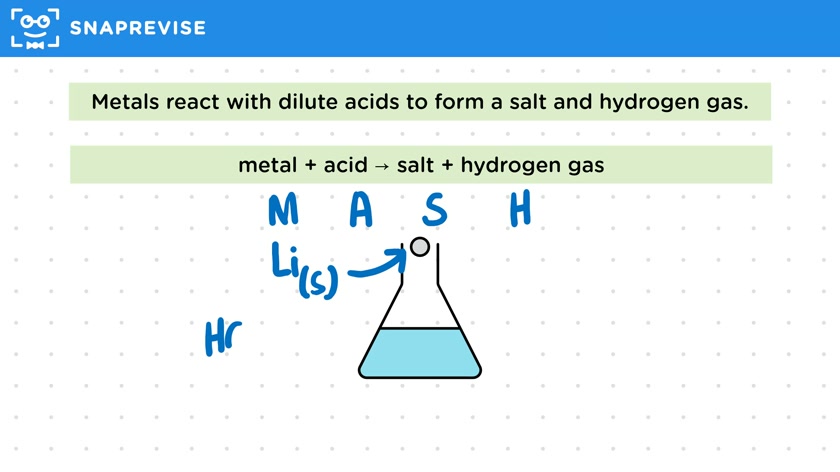
- Metals react with dilute acids to form a salt and hydrogen gas (MASH acronym).
- Example: Lithium metal added to hydrochloric acid forms lithium chloride and hydrogen gas.
- More reactive metals have more vigorous reactions with acids.
- Reactions with acids can also place metals in the reactivity series.
- Zinc reacts more intensely with dilute acids than iron, which reacts more intensely than copper.
- Experimental results can deduce the reactivity of unknown metals.
- Example: Metal Z reacts fast with water, making it the most reactive; Metal X fizzes with acid, making it more reactive than Metal Y.
- Order of reactivity: Z, X, Y.
Please subscribe to access these revision notes.
This, and all other video notes, are included in our premium subscriptions.
Premium accounts get access to all videos and revision notes.
80
questions for Chemical changes
29
questions for Reactivity of metals