
GCSE Chemistry (AQA)
196 videos | 19 hours
Please subscribe to watch this video.
This, and all other videos, are included in our premium subscriptions.
Premium accounts get access to all videos.
Enable autoplay to keep watching
Your browser is blocking videos from playing automatically. To turn it back on:
Safari (Mac): Click the Safari menu item in the top bar, then Settings → Websites → Auto-Play, then set Auto-Play to Allow All Auto-Play for the current website.
Safari (iPhone/iPad): open the Settings app, then Apps → Safari → Auto-Play, and select Allow All Auto-Play.
Reactions of Carboxylic acids
- Carboxylic acids dissolve in water to form acidic solutions.
- Defined by the COOH functional group, which determines key properties.
- When dissolved, a hydrogen splits off from the COOH group, leaving a COO group with a negative charge.
- The hydrogen ion has a positive charge, making the solution acidic.
- Acids release H+ ions when dissolved in water.
- Carboxylic acids can be represented by an equation showing ionization.
- Use a reversible reaction symbol because carboxylic acids only partially ionize, making them weak acids.
- Carboxylic acids typically have a pH value between two and three.
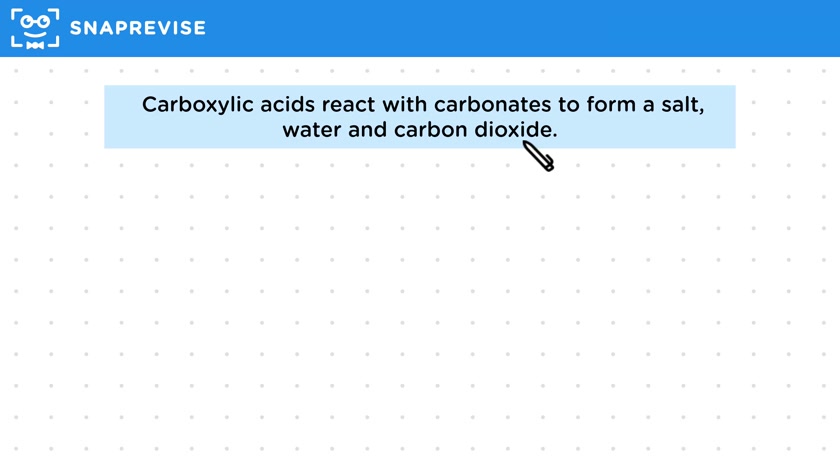
- Carboxylic acids react with carbonates to form salt, water, and carbon dioxide.
- Example reaction: chalk (calcium carbonate) and vinegar (ethanoic acid) produce CO2 gas.
- Carboxylic acids react with alcohols to form esters, which have fruity smells and are used in fragrances and solvents.
- Example: Ethanol reacts with ethanoic acid to form ethyl ethanoate and water.
- The reaction involves the combination of hydrogen from alcohol and OH group from acid to form water, and a new bond forms between oxygen in alcohol and carbon in acid to create the ester.
Please subscribe to access these revision notes.
This, and all other video notes, are included in our premium subscriptions.
Premium accounts get access to all videos and revision notes.
83
questions for Organic chemistry
33
questions for Reactions of alkenes and alcohols (chemistry only)