
GCSE Chemistry (AQA)
196 videos | 19 hours
Please subscribe to watch this video.
This, and all other videos, are included in our premium subscriptions.
Premium accounts get access to all videos.
Enable autoplay to keep watching
Your browser is blocking videos from playing automatically. To turn it back on:
Safari (Mac): Click the Safari menu item in the top bar, then Settings → Websites → Auto-Play, then set Auto-Play to Allow All Auto-Play for the current website.
Safari (iPhone/iPad): open the Settings app, then Apps → Safari → Auto-Play, and select Allow All Auto-Play.
Starch & Cellulose
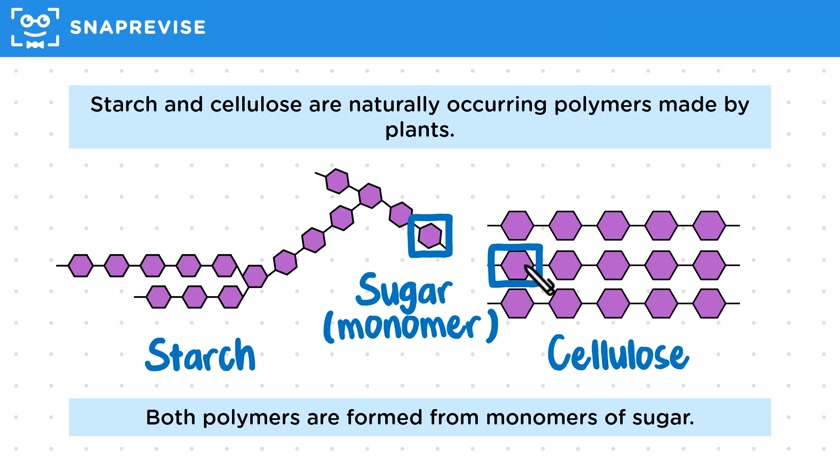
- Starch and cellulose are naturally occurring polymers made by plants.
- Polymers are molecules consisting of long chains of monomers.
- Examples of polymers include polypeptides and DNA, which are essential for life.
- Starch and cellulose are important natural polymers to be familiar with for exams.
- Starch has long, complex chains of monomers, while cellulose has more organized chains.
- Both polymers are formed from sugar monomers.
- Sugar molecules bond together to form polymer chains.
- Starch and cellulose are important for life and are studied in biology.
- Starch is used by plants to store energy and is found in vegetables like corn and potatoes.
- Our bodies convert starch to glucose for energy.
- Cellulose is used to make plant cell walls, providing strength to leaves and plant matter.
- The rigid structure of cellulose contributes to the strength of plant cell walls.
Please subscribe to access these revision notes.
This, and all other video notes, are included in our premium subscriptions.
Premium accounts get access to all videos and revision notes.
83
questions for Organic chemistry
19
questions for Synthetic and naturally occurring polymers (chemistry only)