
GCSE Chemistry (AQA)
196 videos | 19 hours
Please subscribe to watch this video.
This, and all other videos, are included in our premium subscriptions.
Premium accounts get access to all videos.
Enable autoplay to keep watching
Your browser is blocking videos from playing automatically. To turn it back on:
Safari (Mac): Click the Safari menu item in the top bar, then Settings → Websites → Auto-Play, then set Auto-Play to Allow All Auto-Play for the current website.
Safari (iPhone/iPad): open the Settings app, then Apps → Safari → Auto-Play, and select Allow All Auto-Play.
Testing for Anions
- Chemical tests can identify specific ions in a solution.
- An ion is a negatively charged particle formed by an atom gaining electrons.
- Examples of ions include carbonate ions (C3 two minus), halide ions (CL minus), and sulfate ions (SO four two minus).
- Carbonate ions can be detected by adding a dilute acid, such as hydrochloric acid, to the sample.
- If carbonate ions are present, CO2 bubbles will be produced, which can be identified using lime water that turns cloudy.
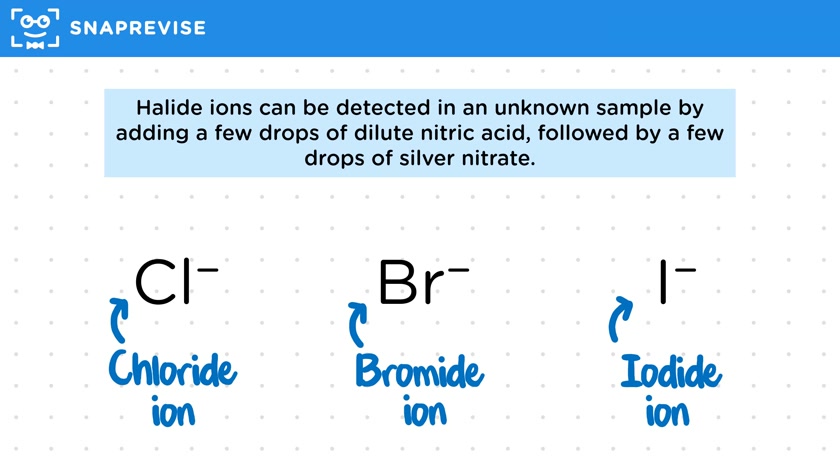
- Halide ions can be detected by adding dilute nitric acid followed by silver nitrate.
- Halide ions include chloride (CL minus), bromide (BR minus), and iodide (I minus).
- Silver chloride forms a white precipitate, silver bromide forms a cream precipitate, and silver iodide forms a yellow precipitate.
- Sulfate ions can be detected by adding dilute hydrochloric acid and barium chloride solution.
- If sulfate ions are present, a white precipitate will form.
- The tests and results for these ions are important for exams.
Please subscribe to access these revision notes.
This, and all other video notes, are included in our premium subscriptions.
Premium accounts get access to all videos and revision notes.
30
questions for Chemical analysis
9
questions for Identification of ions by chemical and spectroscopic means (chemistry only)