
GCSE Chemistry (AQA)
196 videos | 19 hours
Please subscribe to watch this video.
This, and all other videos, are included in our premium subscriptions.
Premium accounts get access to all videos.
Enable autoplay to keep watching
Your browser is blocking videos from playing automatically. To turn it back on:
Safari (Mac): Click the Safari menu item in the top bar, then Settings → Websites → Auto-Play, then set Auto-Play to Allow All Auto-Play for the current website.
Safari (iPhone/iPad): open the Settings app, then Apps → Safari → Auto-Play, and select Allow All Auto-Play.
The Haber Process
- Nitrogen-based fertilizers are produced using ammonia.
- Fertilizers help plant growth and increase crop yield.
- Ammonia production is crucial to meet fertilizer demand.
- Ammonia is a covalent compound with the formula NH3.
- Ammonia is manufactured using the Haber process, developed by Fritz Haber and Carl Bosch.
- In the Haber process, nitrogen and hydrogen react to form ammonia.
- Nitrogen is sourced from the air; hydrogen is primarily extracted from methane (CH4).
- The reaction uses a double-ended arrow, indicating it is reversible.
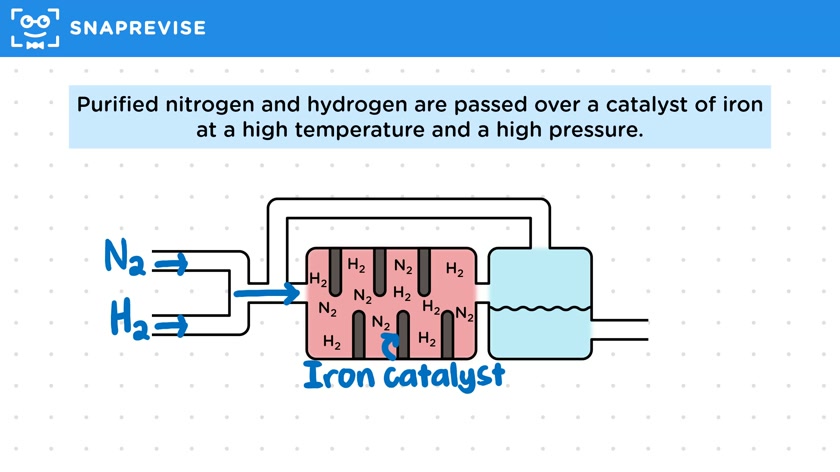
- Purified nitrogen and hydrogen are passed over an iron catalyst at high temperature and pressure.
- The setup involves purified gases being pumped into a system where they react in a chamber with iron as a catalyst.
- The catalyst lowers the activation energy, speeding up the reaction.
- The chamber is kept at around 450��C and 200 atmospheres.
- Some hydrogen and nitrogen react to form ammonia, but the reaction is reversible.
- The reaction mixture is cooled to liquefy ammonia for removal.
- Ammonia has a higher boiling point than hydrogen and nitrogen, allowing it to condense and be collected.
- Unreacted hydrogen and nitrogen gases are recycled back into the reaction chamber.
- Understanding the steps of the Haber process is important for exams.
Please subscribe to access these revision notes.
This, and all other video notes, are included in our premium subscriptions.
Premium accounts get access to all videos and revision notes.
18
questions for Using resources
11
questions for The Haber process and the use of NPK fertilisers (chemistry only)