
GCSE Chemistry (AQA)
196 videos | 19 hours
Please subscribe to watch this video.
This, and all other videos, are included in our premium subscriptions.
Premium accounts get access to all videos.
Enable autoplay to keep watching
Your browser is blocking videos from playing automatically. To turn it back on:
Safari (Mac): Click the Safari menu item in the top bar, then Settings → Websites → Auto-Play, then set Auto-Play to Allow All Auto-Play for the current website.
Safari (iPhone/iPad): open the Settings app, then Apps → Safari → Auto-Play, and select Allow All Auto-Play.
The Haber Process: Equilibrium
- Principles of dynamic equilibrium apply to the Haber process.
- The Haber process produces ammonia from nitrogen and hydrogen.
- The reaction is reversible; ammonia can break down back into nitrogen and hydrogen.
- Changing temperature and pressure affects ammonia yield and production rate.
- Commercial production of ammonia aims to maximize profits due to high demand in agriculture.
- Increasing pressure increases ammonia yield at a constant temperature by shifting equilibrium to the side with fewer gas molecules.
- The Haber process uses a pressure of 200 atmospheres as a compromise between yield and cost.
- Higher pressures increase yield but require expensive equipment and energy.
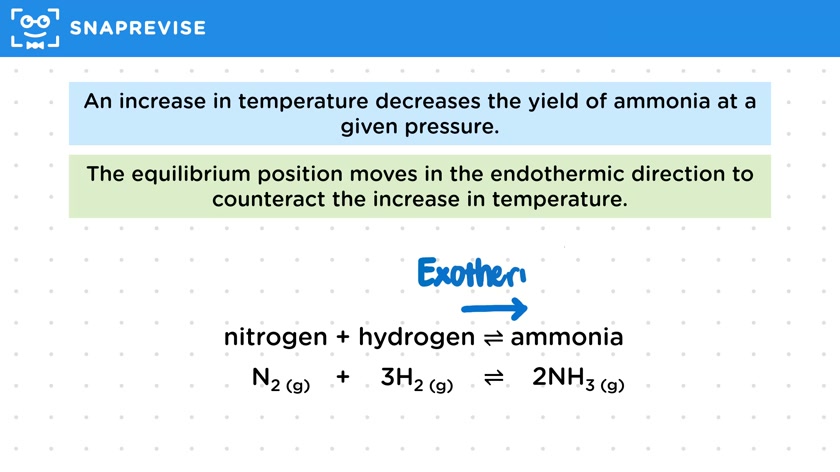
- Increasing temperature decreases ammonia yield at a given pressure by shifting equilibrium in the endothermic direction.
- The Haber process uses a temperature of 450 degrees Celsius as a compromise between yield, rate, and cost.
- Lower temperatures increase yield but slow down production.
- An iron catalyst is used to increase reaction rate without affecting equilibrium position or yield.
- Raw material costs, such as purified hydrogen and nitrogen, are significant in ammonia production.
- Unreacted nitrogen and hydrogen are recycled to reduce costs and waste.
Please subscribe to access these revision notes.
This, and all other video notes, are included in our premium subscriptions.
Premium accounts get access to all videos and revision notes.
18
questions for Using resources
11
questions for The Haber process and the use of NPK fertilisers (chemistry only)