
GCSE Chemistry (AQA)
196 videos | 19 hours
Please subscribe to watch this video.
This, and all other videos, are included in our premium subscriptions.
Premium accounts get access to all videos.
Enable autoplay to keep watching
Your browser is blocking videos from playing automatically. To turn it back on:
Safari (Mac): Click the Safari menu item in the top bar, then Settings → Websites → Auto-Play, then set Auto-Play to Allow All Auto-Play for the current website.
Safari (iPhone/iPad): open the Settings app, then Apps → Safari → Auto-Play, and select Allow All Auto-Play.
The Particle Theory
- Most substances can be categorized into one of the three states of matter: solid, liquid, and gas.
- Examples:
- Solid: Blue cubes of ice.
- Liquid: Room temperature water in a glass.
- Gas: Steam from a boiling pot of water.
- There are more states of matter, such as plasma, but they are not needed for the exam.
- The particle model is used to represent the three states of matter.
- In the particle model, particles are represented as small solid spheres.
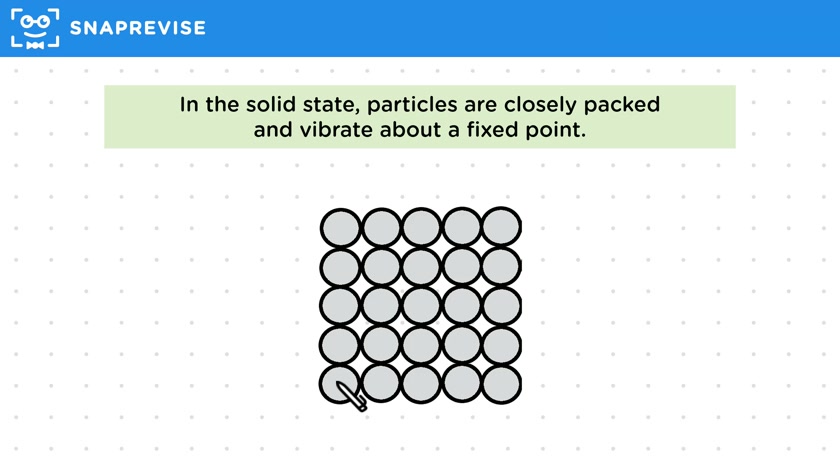
- Solid state:
- Particles are closely packed and vibrate about a fixed point.
- Solids have a definite shape and volume with particles in a regular pattern.
- Liquid state:
- Particles are close together but can move freely and randomly.
- Liquids have a definite volume but no definite shape, taking the shape of their container.
- Gas state:
- Particles are far apart, moving in all directions, and arranged randomly.
- Gases have no definite shape or volume and expand to fill any container.
Please subscribe to access these revision notes.
This, and all other video notes, are included in our premium subscriptions.
Premium accounts get access to all videos and revision notes.
40
questions for Bonding, structure, and the properties of matter
11
questions for How bonding and structure are related to the properties of substances