
GCSE Chemistry (AQA)
196 videos | 19 hours
Please subscribe to watch this video.
This, and all other videos, are included in our premium subscriptions.
Premium accounts get access to all videos.
Enable autoplay to keep watching
Your browser is blocking videos from playing automatically. To turn it back on:
Safari (Mac): Click the Safari menu item in the top bar, then Settings → Websites → Auto-Play, then set Auto-Play to Allow All Auto-Play for the current website.
Safari (iPhone/iPad): open the Settings app, then Apps → Safari → Auto-Play, and select Allow All Auto-Play.
Transition Elements: Ions & Compounds
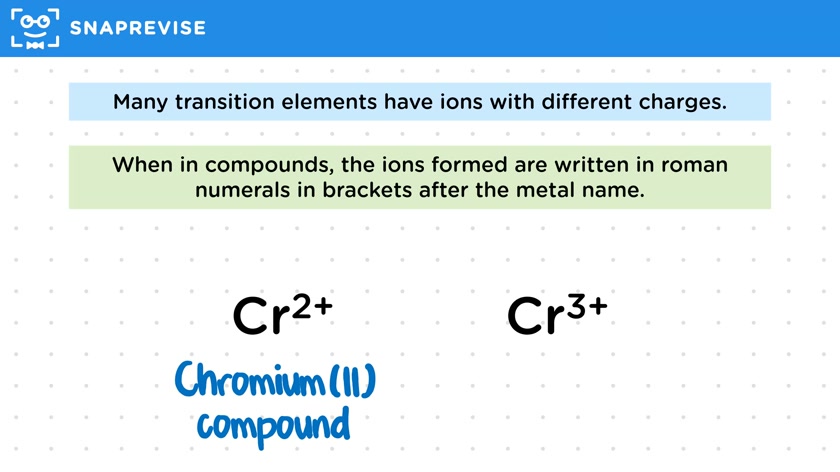
- Transition elements can form ions with different charges.
- Common transition metals typically form at least two ions, usually a 2+ and a 3+ charge.
- Nickel and copper can form 1+ and 2+ ions.
- Manganese can form up to five different ions, with charges up to 7+.
- Memorizing specific ion charges is not necessary for exams, but understanding the general property is important.
- Transition elements are named for their ability to transition between different charges.
- Chromium ions, for example, can transition between CR 2+ and CR 3+ by losing or gaining an electron.
- In compounds, ion charges are indicated with Roman numerals in brackets after the metal name.
- Transition metals form colored compounds, and the color depends on the ion's charge.
- Examples include chromium, manganese, iron, cobalt, nickel, and copper.
- The charge of the ion, not just the element, determines the compound's color.
- Transition metals are used as catalysts, such as in catalytic converters in cars.
- Catalytic converters contain rhodium, a transition metal, to reduce polluting gases.
- They convert harmful gases like carbon monoxide into less harmful gases like carbon dioxide.
Please subscribe to access these revision notes.
This, and all other video notes, are included in our premium subscriptions.
Premium accounts get access to all videos and revision notes.
60
questions for Atomic structure and the periodic table
3
questions for Properties of transition metals (chemistry only)