
GCSE Chemistry (AQA)
196 videos | 19 hours
Please subscribe to watch this video.
This, and all other videos, are included in our premium subscriptions.
Premium accounts get access to all videos.
Enable autoplay to keep watching
Your browser is blocking videos from playing automatically. To turn it back on:
Safari (Mac): Click the Safari menu item in the top bar, then Settings → Websites → Auto-Play, then set Auto-Play to Allow All Auto-Play for the current website.
Safari (iPhone/iPad): open the Settings app, then Apps → Safari → Auto-Play, and select Allow All Auto-Play.
Uncertainty
- Apparatus used in chemistry for measuring liquid volumes include pipettes, burettes, and measuring beakers.
- The choice of apparatus depends on the volume needed and the purpose, e.g., burettes are preferred for titrations.
- Measurement uncertainty arises due to equipment precision, which affects reliability.
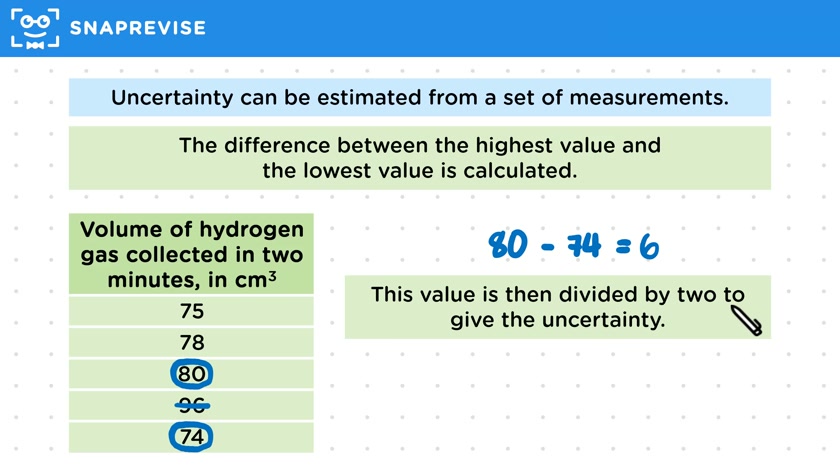
- Uncertainty can be estimated from repeated measurements.
- Example experiment: measuring hydrogen gas volume collected in two minutes using a gas syringe.
- Anomalous results should be ignored when calculating the mean.
- Example: 96 is an anomalous result; mean calculated from 75, 78, 80, 74 is 76.75 cm��.
- Uncertainty is calculated as half the difference between the highest and lowest values.
- Example: difference between 80 and 74 is 6, giving an uncertainty of 3 cm��.
- Results are recorded as mean �� uncertainty, e.g., 76.75 �� 3 cm��.
- Another example: measuring HCL volume to neutralize NAOH, ignoring anomalous 31.25.
- Mean calculated from 22.50, 22.80, 22.65 is 22.65 cm��.
- Difference between highest (22.80) and lowest (22.50) is 0.3, giving uncertainty of 0.15.
- Final result: 22.65 �� 0.15 cm��.
Please subscribe to access these revision notes.
This, and all other video notes, are included in our premium subscriptions.
Premium accounts get access to all videos and revision notes.
19
questions for Quantitative chemistry
4
questions for Chemical measurements, conservation of mass and the quantitative interpretation of chemical equations