
GCSE Chemistry (AQA)
196 videos | 19 hours
Please subscribe to watch this video.
This, and all other videos, are included in our premium subscriptions.
Premium accounts get access to all videos.
Enable autoplay to keep watching
Your browser is blocking videos from playing automatically. To turn it back on:
Safari (Mac): Click the Safari menu item in the top bar, then Settings → Websites → Auto-Play, then set Auto-Play to Allow All Auto-Play for the current website.
Safari (iPhone/iPad): open the Settings app, then Apps → Safari → Auto-Play, and select Allow All Auto-Play.
Using Moles to Balance Equations
- Chemical equations can be interpreted in terms of moles.
- Balanced equations indicate the moles of reactants and products.
- Example: Magnesium reacts with hydrochloric acid to produce magnesium chloride and hydrogen.
- Multipliers in equations represent moles and ensure conservation of mass.
- For magnesium and hydrochloric acid reaction, 2 moles of hydrochloric acid are needed for 1 mole of magnesium.
- Balancing numbers in equations can be calculated from masses of reactants and products.
- Example: Hydrogen and oxygen react to produce water; masses are converted to moles.
- Moles are calculated using the formula: Moles = Mass in grams / Relative formula mass.
- Simplify mole ratios to whole numbers for balancing equations.
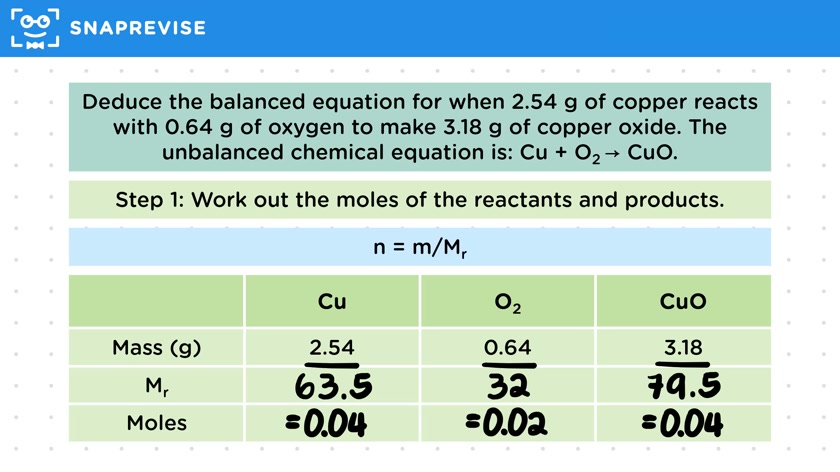
- Example: Copper reacts with oxygen to form copper oxide; use given masses to balance the equation.
- Use periodic table to find MR values for compounds.
- Calculate moles for each reactant and product, then simplify the ratio.
- If ratios are not whole numbers, multiply to convert to whole numbers.
- Example: Iron reacts with oxygen to form iron oxide; balance using mole ratios.
- Ensure balanced equations have equal atoms on both sides.
Please subscribe to access these revision notes.
This, and all other video notes, are included in our premium subscriptions.
Premium accounts get access to all videos and revision notes.
19
questions for Quantitative chemistry
13
questions for Use of amount of substance in relation to masses of pure substances