
GCSE Chemistry (AQA)
196 videos | 19 hours
Please subscribe to watch this video.
This, and all other videos, are included in our premium subscriptions.
Premium accounts get access to all videos.
Enable autoplay to keep watching
Your browser is blocking videos from playing automatically. To turn it back on:
Safari (Mac): Click the Safari menu item in the top bar, then Settings → Websites → Auto-Play, then set Auto-Play to Allow All Auto-Play for the current website.
Safari (iPhone/iPad): open the Settings app, then Apps → Safari → Auto-Play, and select Allow All Auto-Play.
Volumes of Gases
- The volume of a gas varies with temperature and pressure.
- Increasing temperature increases the volume of gas.
- Gas molecules move faster at higher temperatures.
- Increasing pressure decreases the volume of gas.
- Gas molecules are forced together under higher pressure.
- The volume of gas also depends on the number of moles.
- Equal amounts in moles of gases occupy the same volume under the same conditions of temperature and pressure.
- This principle holds true regardless of the gas identity.
- Example: One mole of hydrogen (H2) and one mole of carbon dioxide (CO2) occupy the same volume under standard conditions.
- At room temperature (20��C) and pressure (1 atmosphere), one mole of any gas occupies 24 dm��.
- This volume is referred to as the molar volume.
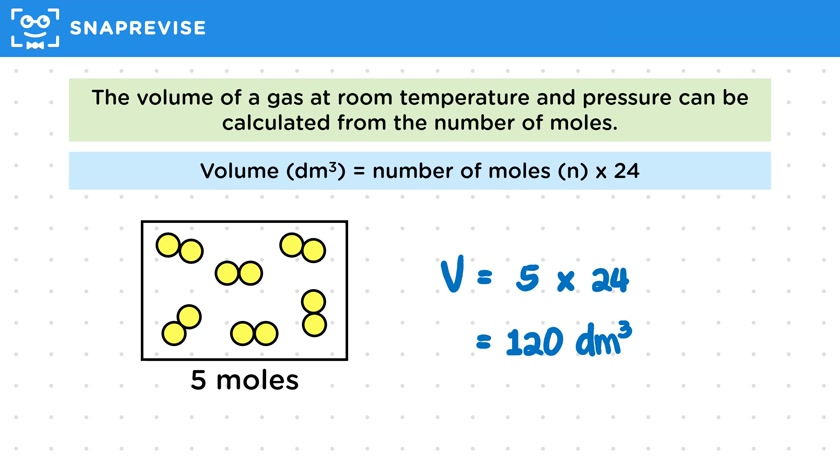
- Volume of gas at room temperature and pressure can be calculated using the equation: Volume (dm��) = Number of moles (N) �� 24 dm��.
- Example calculation: 5 moles of gas at room temperature and pressure occupy 120 dm��.
- To calculate the volume of 0.4 moles of C2H6 gas: Volume = 0.4 �� 24 = 9.6 dm��.
- Volume of gas can also be calculated from its mass by first converting mass to moles using the equation: N = Mass (M) / Relative formula mass (Mr).
- Example calculation: Find the volume of 0.66 grams of CO2 gas.
- Step 1: Calculate moles: N = 0.66 / 44 = 0.015 moles.
- Step 2: Calculate volume: Volume = 0.015 �� 24 = 0.36 dm��.
Please subscribe to access these revision notes.
This, and all other video notes, are included in our premium subscriptions.
Premium accounts get access to all videos and revision notes.
19
questions for Quantitative chemistry
1
questions for Use of amount of substance in relation to volumes of gases (chemistry only) (HT only)