
GCSE Combined Science (AQA)
622 videos | 38 hours
Please subscribe to watch this video.
This, and all other videos, are included in our premium subscriptions.
Premium accounts get access to all videos.
Enable autoplay to keep watching
Your browser is blocking videos from playing automatically. To turn it back on:
Safari (Mac): Click the Safari menu item in the top bar, then Settings → Websites → Auto-Play, then set Auto-Play to Allow All Auto-Play for the current website.
Safari (iPhone/iPad): open the Settings app, then Apps → Safari → Auto-Play, and select Allow All Auto-Play.
Advanced Chemical Equations
- Extra care is needed when balancing complicated equations.
- Balancing equations is an essential skill for exams and should be practiced.
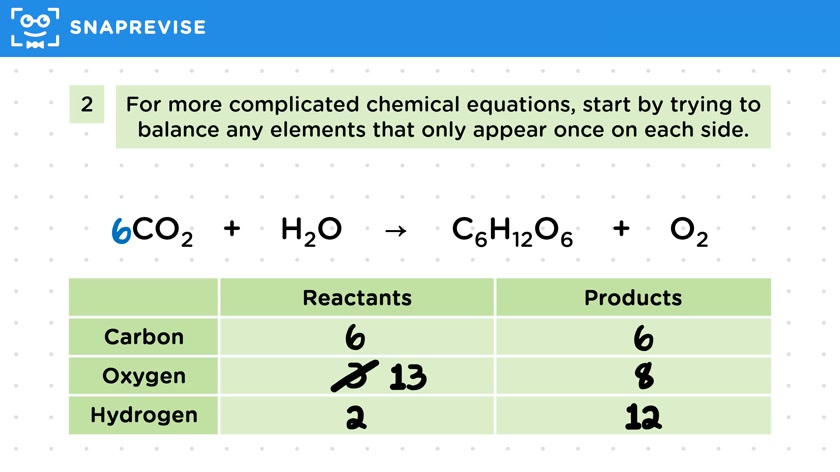
- The video explains balancing the equation where carbon dioxide and water produce glucose and oxygen, a photosynthesis reaction.
- To balance the equation, the same number of each type of atom is needed on each side.
- Keeping track of atom numbers in a table is good practice.
- Oxygen atoms in each molecule can make balancing tricky.
- Step 1: Count the number of atoms of each element on each side of the equation.
- Reactants: 1 carbon, 3 oxygens, 2 hydrogens.
- Products: 6 carbons, 8 oxygens, 12 hydrogens.
- The equation is not balanced initially.
- Step 2: Balance elements that appear once on each side.
- Carbon atoms appear once on each side; balance by adding a multiplier to carbon dioxide.
- Update the table for changes in carbon and oxygen numbers.
- Step 3: Identify elements that still need balancing.
- Balance hydrogen by adding a multiplier to water.
- Update the table for changes in hydrogen and oxygen numbers.
- Step 4: Balance remaining elements using trial and error.
- Change the number of oxygen molecules to balance oxygen without affecting carbon and hydrogen.
- Calculate the needed number of oxygen molecules.
- Step 5: Recount to check numbers are balanced.
- Double-check the equation is balanced after solving.
- Successfully balanced the equation with 6 carbon, 18 oxygen, and 12 hydrogen atoms on both sides.
Please subscribe to access these revision notes.
This, and all other video notes, are included in our premium subscriptions.
Premium accounts get access to all videos and revision notes.
57
questions for Atomic structure and the periodic table
52
questions for A simple model of the atom, symbols, relative atomic mass, electronic charge and isotopes