
GCSE Combined Science (AQA)
622 videos | 38 hours
Please subscribe to watch this video.
This, and all other videos, are included in our premium subscriptions.
Premium accounts get access to all videos.
Enable autoplay to keep watching
Your browser is blocking videos from playing automatically. To turn it back on:
Safari (Mac): Click the Safari menu item in the top bar, then Settings → Websites → Auto-Play, then set Auto-Play to Allow All Auto-Play for the current website.
Safari (iPhone/iPad): open the Settings app, then Apps → Safari → Auto-Play, and select Allow All Auto-Play.
Applying the Linnaean System
- For the exam, understanding the Linnaean system is required.
- Example given: classification of a red fox, known as Veers.
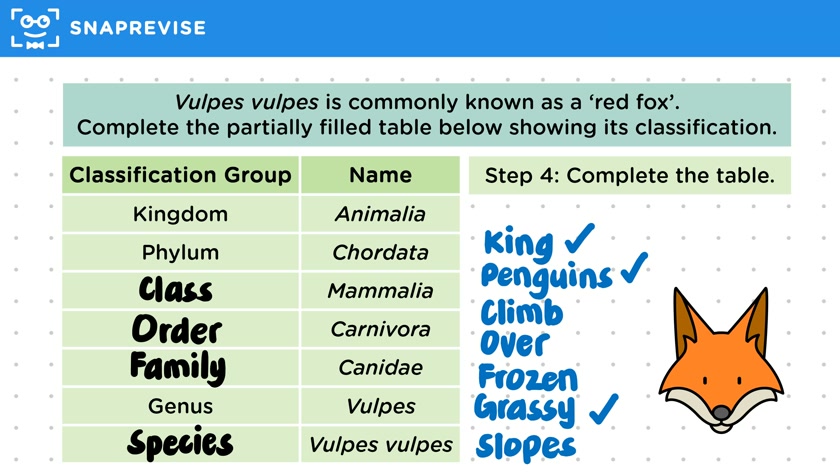
- Instructions include completing a partially filled table with classification details.
- Step one involves reading the table and identifying the command word, which is "complete."
- "Complete" means to add missing information to the table.
- The table has classification groups on the left and corresponding names on the right.
- Step two involves using a mnemonic ("King penguins climb over frozen grassy slopes") to remember classification groups.
- Step three links the mnemonic to the groups, filling in the missing classifications such as class, order, family, and species.
- Step four completes the table using the mnemonic.
- Additional application of the Linnaean system includes comparing the red fox to other animals to determine closest relations.
- By comparing classification groups, it is determined that the lion, being in the same order (Carnivore), is more closely related to the red fox than humans, who are in the order Primates.
- In an exam setting, the answer would state that the lion is most closely related to the red fox due to their shared order.
Please subscribe to access these revision notes.
This, and all other video notes, are included in our premium subscriptions.
Premium accounts get access to all videos and revision notes.
81
questions for Inheritance, Variation and Evolution
1
questions for Classification of Living Organisms