
GCSE Combined Science (AQA)
622 videos | 38 hours
Please subscribe to watch this video.
This, and all other videos, are included in our premium subscriptions.
Premium accounts get access to all videos.
Enable autoplay to keep watching
Your browser is blocking videos from playing automatically. To turn it back on:
Safari (Mac): Click the Safari menu item in the top bar, then Settings → Websites → Auto-Play, then set Auto-Play to Allow All Auto-Play for the current website.
Safari (iPhone/iPad): open the Settings app, then Apps → Safari → Auto-Play, and select Allow All Auto-Play.
Balanced Chemical Equations
- Importance of balancing chemical equations
- Conservation of mass principle: no atoms lost or created
- Balanced equation: equal number of atoms of each element on both sides
- Example: sodium and chlorine reaction
- Initial unbalanced equation: loss of chlorine atom
- Balancing by adding multipliers in front of reactants/products
- Example: adding "2" in front of sodium and sodium chloride
- Multipliers indicate the number of molecules, not individual atoms
- Subscripts in equations must not be changed
- Changing subscripts alters the type of molecule
- Structured method for balancing equations
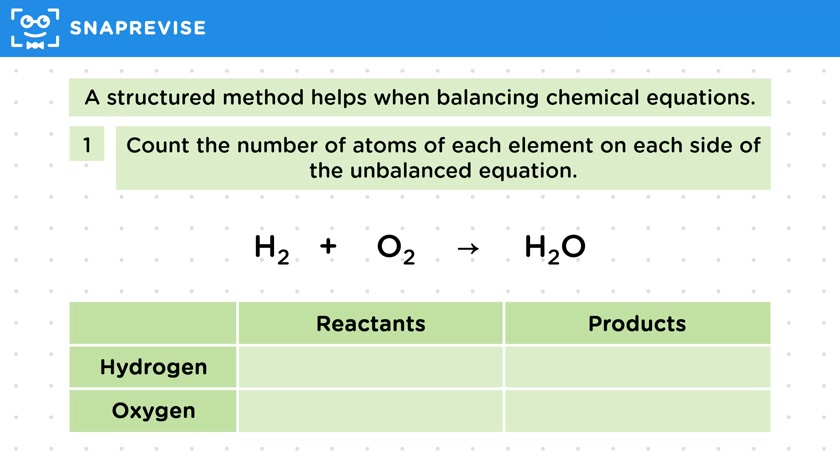
- Example: balancing hydrogen and oxygen to form water
- Step 1: Count atoms of each element on both sides
- Step 2: Identify unbalanced elements
- Step 3: Identify side with fewer atoms
- Step 4: Use subscripts as multipliers
- Step 5: Recount atoms after adding multipliers
- Step 6: Repeat process if still unbalanced
- Example: balancing hydrogen and oxygen using trial and error
- Final balanced equation: equal number of hydrogen and oxygen atoms on both sides
- Practice is essential for mastering balancing equations
- Other faster methods may exist
Please subscribe to access these revision notes.
This, and all other video notes, are included in our premium subscriptions.
Premium accounts get access to all videos and revision notes.
57
questions for Atomic structure and the periodic table
52
questions for A simple model of the atom, symbols, relative atomic mass, electronic charge and isotopes