
GCSE Combined Science (AQA)
622 videos | 38 hours
Please subscribe to watch this video.
This, and all other videos, are included in our premium subscriptions.
Premium accounts get access to all videos.
Enable autoplay to keep watching
Your browser is blocking videos from playing automatically. To turn it back on:
Safari (Mac): Click the Safari menu item in the top bar, then Settings → Websites → Auto-Play, then set Auto-Play to Allow All Auto-Play for the current website.
Safari (iPhone/iPad): open the Settings app, then Apps → Safari → Auto-Play, and select Allow All Auto-Play.
Beta Decay Equations
- Beta decay involves a nucleus losing a neutron and gaining a proton.
- Nuclei undergoing beta decay typically have more neutrons than protons.
- A beta particle is a free electron carrying a negative charge.
- In beta decay, a neutron becomes a proton, but understanding the process is not necessary for exams.
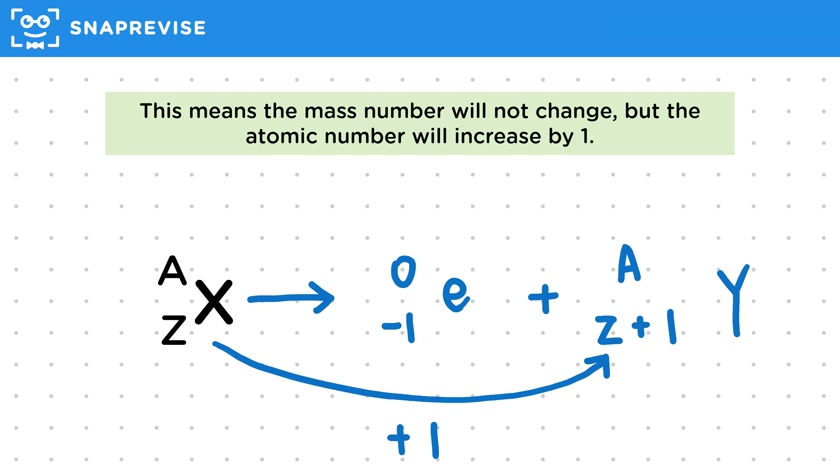
- The mass number remains unchanged, while the atomic number increases by one.
- In atomic notation, A is the mass number (protons + neutrons), Z is the atomic number (protons), and X represents the element.
- Beta decay can be represented with a nuclear equation, similar to a chemical equation.
- The beta particle is represented as an electron with no mass and a negative charge.
- The new nucleus (Y) is a different element from the original (X) due to the change in the number of protons.
- The mass number does not change as no particles are added or removed, only transformed.
- The atomic number increases by one due to the additional proton.
- The equation is verified by ensuring A and Z are the same on both sides.
- The atomic number of the electron is minus one to balance the additional proton.
- Example: Cobalt-60 with 27 protons and 33 neutrons undergoes beta decay to become Nickel.
- Cobalt-60 is written in atomic notation with a mass number of 60 and atomic number of 27.
- The atomic number is increased by one, resulting in 28 protons for Nickel.
- The nuclear equation: Cobalt-60 emits a beta particle (electron) and becomes Nickel with a mass number of 60 and atomic number of 28.
Please subscribe to access these revision notes.
This, and all other video notes, are included in our premium subscriptions.
Premium accounts get access to all videos and revision notes.
111
questions for Atomic structure
71
questions for Atoms and nuclear radiation