
GCSE Combined Science (AQA)
622 videos | 38 hours
Please subscribe to watch this video.
This, and all other videos, are included in our premium subscriptions.
Premium accounts get access to all videos.
Enable autoplay to keep watching
Your browser is blocking videos from playing automatically. To turn it back on:
Safari (Mac): Click the Safari menu item in the top bar, then Settings → Websites → Auto-Play, then set Auto-Play to Allow All Auto-Play for the current website.
Safari (iPhone/iPad): open the Settings app, then Apps → Safari → Auto-Play, and select Allow All Auto-Play.
Blood Vessels
- Blood is circulated around the body through blood vessels, collectively known as the circulatory system.
- There are three main types of blood vessels: arteries, veins, and capillaries.
- Arteries carry oxygen-rich blood from the heart to various organs and tissues, functioning under high pressure with thick walls composed of muscle and elastic tissue.
- The narrow lumen in arteries helps maintain high blood pressure.
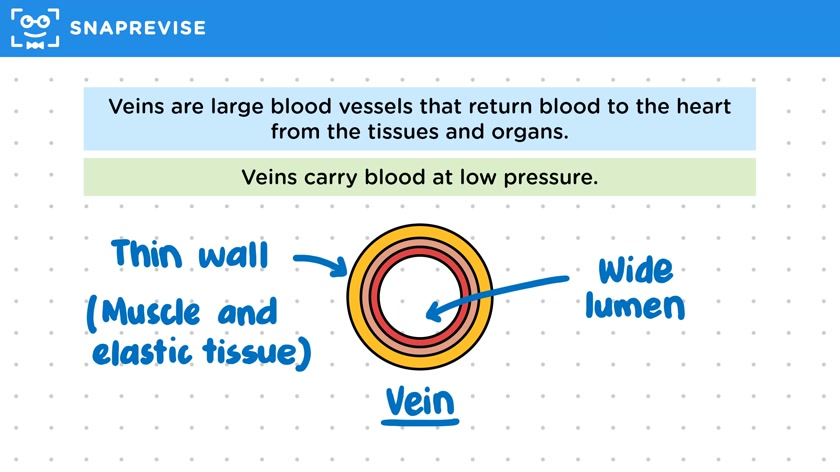
- Veins return oxygen-depleted blood back to the heart from tissues and organs, operating under low pressure with thinner walls and a wider lumen compared to arteries.
- Veins are equipped with one-way valves that prevent the backflow of blood, ensuring a unidirectional flow.
- Capillaries are tiny blood vessels that facilitate the exchange of oxygen, carbon dioxide, and other nutrients between blood and cells.
- Capillary walls are extremely thin, made of endothelial cells one cell thick, optimizing the diffusion process.
- The structure of each type of blood vessel is closely related to its specific function in the circulatory system.
Please subscribe to access these revision notes.
This, and all other video notes, are included in our premium subscriptions.
Premium accounts get access to all videos and revision notes.
55
questions for Organisation
47
questions for Animal Tissues, Organs and Organ Systems