
GCSE Combined Science (AQA)
622 videos | 38 hours
Please subscribe to watch this video.
This, and all other videos, are included in our premium subscriptions.
Premium accounts get access to all videos.
Enable autoplay to keep watching
Your browser is blocking videos from playing automatically. To turn it back on:
Safari (Mac): Click the Safari menu item in the top bar, then Settings → Websites → Auto-Play, then set Auto-Play to Allow All Auto-Play for the current website.
Safari (iPhone/iPad): open the Settings app, then Apps → Safari → Auto-Play, and select Allow All Auto-Play.
Bond Energy Calculations
- Energy change in a reaction can be calculated using bond energies.
- Bond energy is the amount of energy needed to break one mole of a given covalent bond.
- Energy is needed to break bonds.
- Example: 412 kJ to break one mole of C-H bonds, 799 kJ to break one mole of C=O double bonds.
- Total energy needed to break bonds in a molecule is the sum of bond energies for all bonds in the molecule.
- Example: Methane (CH4) has 4 C-H bonds, total energy to break = 4 x 412 kJ = 1,648 kJ.
- Example: Carbon dioxide (CO2) has 2 C=O double bonds, total energy to break = 2 x 799 kJ = 1,598 kJ.
- Energy released when forming a bond is the same as the energy needed to break the bond.
- Total energy released when forming a molecule is the sum of energy released when each bond forms.
- Example: Methane formation releases 1,648 kJ, CO2 formation releases 1,598 kJ.
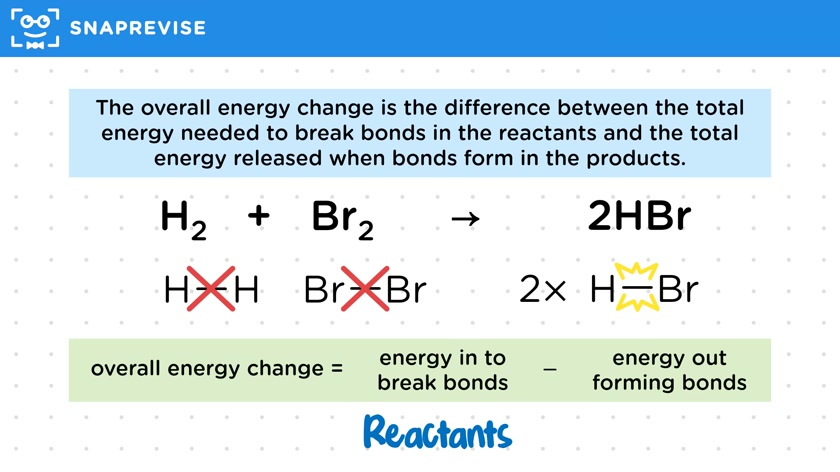
- During reactions, reactant bonds are broken and product bonds are formed.
- Overall energy change = energy needed to break reactant bonds - energy released when forming product bonds.
- Exothermic reaction: less energy needed to break reactant bonds than released forming product bonds.
- Example: H2 + Br2 -> 2 HBr, energy change = 629 kJ (breaking) - 732 kJ (forming) = -103 kJ (exothermic).
- Endothermic reaction: more energy needed to break reactant bonds than released forming product bonds.
- Example: Reverse of HBr formation, energy change = 732 kJ (breaking) - 629 kJ (forming) = +103 kJ (endothermic).
- Example calculation: 2 H2 + O2 -> 2 H2O.
- Step 1: Energy needed to break reactant bonds = 2 x 432 kJ (H-H) + 496 kJ (O=O) = 1,360 kJ.
- Step 2: Energy released forming product bonds = 2 x 2 x 463 kJ (H-O) = 1,852 kJ.
- Step 3: Energy change = 1,360 kJ - 1,852 kJ = -492 kJ.
- Step 4: Negative energy change indicates exothermic reaction.
- Exothermic reaction: more energy released by bond formation than taken in to break bonds, energy released to surroundings.
Please subscribe to access these revision notes.
This, and all other video notes, are included in our premium subscriptions.
Premium accounts get access to all videos and revision notes.
29
questions for Energy changes
29
questions for Exothermic and endothermic reactions