
GCSE Combined Science (AQA)
622 videos | 38 hours
Please subscribe to watch this video.
This, and all other videos, are included in our premium subscriptions.
Premium accounts get access to all videos.
Enable autoplay to keep watching
Your browser is blocking videos from playing automatically. To turn it back on:
Safari (Mac): Click the Safari menu item in the top bar, then Settings → Websites → Auto-Play, then set Auto-Play to Allow All Auto-Play for the current website.
Safari (iPhone/iPad): open the Settings app, then Apps → Safari → Auto-Play, and select Allow All Auto-Play.
Calculating Density
- Density is mass per unit volume, expressed as density = mass/volume.
- Mass can be measured using a pan balance; volume can be measured by submerging the object in water.
- Density equation in symbol form: �� = M/V.
- Mass is measured in kilograms, volume in meters cubed, and density in kilograms per meter cubed.
- The density equation is provided in exams, but understanding its use with correct units is necessary.
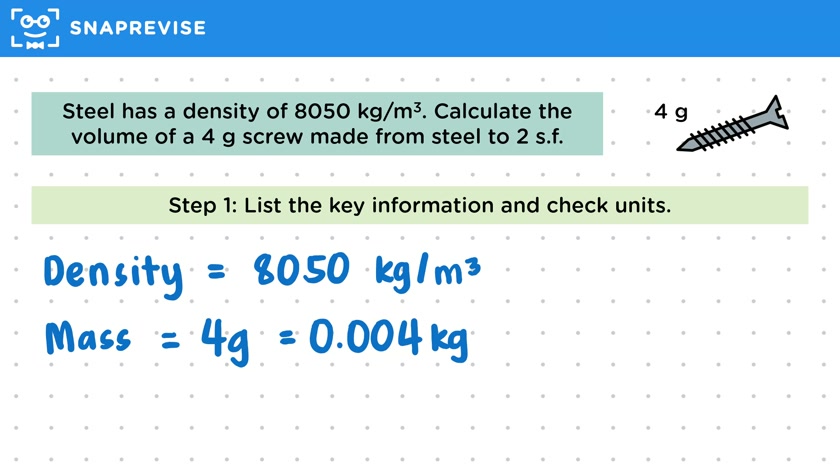
- Example: Steel density is 8,050 kg/m��. Calculate the volume of a 4g steel screw to two significant figures.
- Step 1: List key information and check units. Density = 8,050 kg/m��, mass = 4g (0.004 kg).
- Step 2: Rearrange the density equation to solve for volume: volume = mass/density.
- Step 3: Substitute values to calculate volume: 0.004 kg / 8,050 kg/m�� = 4.968 x 10������ m��.
- Step 4: Round to two significant figures: 4.968 x 10������ m�� rounds to 5.0 x 10������ m��.
- Important to round up to avoid losing marks.
Please subscribe to access these revision notes.
This, and all other video notes, are included in our premium subscriptions.
Premium accounts get access to all videos and revision notes.
89
questions for Particle model of matter
34
questions for Changes of state and the particle model