
GCSE Combined Science (AQA)
622 videos | 38 hours
Please subscribe to watch this video.
This, and all other videos, are included in our premium subscriptions.
Premium accounts get access to all videos.
Enable autoplay to keep watching
Your browser is blocking videos from playing automatically. To turn it back on:
Safari (Mac): Click the Safari menu item in the top bar, then Settings → Websites → Auto-Play, then set Auto-Play to Allow All Auto-Play for the current website.
Safari (iPhone/iPad): open the Settings app, then Apps → Safari → Auto-Play, and select Allow All Auto-Play.
Collision Theory
- Different models can be used to describe enzyme action.
- Lock and key theory is commonly used to explain enzyme action.
- Collision theory is another model that explains enzyme action.
- Collision theory states that for a reaction to occur, the enzyme's active site must successfully collide with its substrate.
- No reaction occurs if there is no collision between the enzyme's active site and the substrate.
- The number of successful collisions affects the level of enzyme activity.
- Factors influencing the number of collisions include temperature and enzyme concentration.
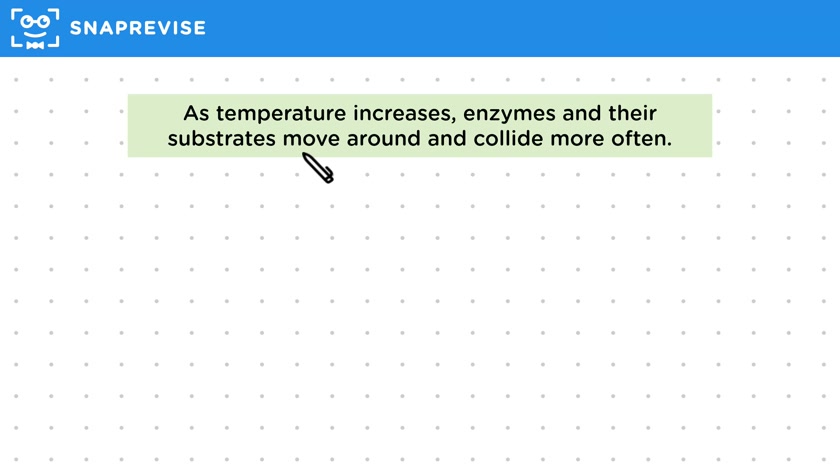
- As temperature increases, enzymes and substrates move more, leading to more frequent collisions.
- Increased temperature results in molecules having more kinetic energy, thus colliding more often.
- Higher temperatures can increase the rate of enzyme-controlled reactions.
- Increasing the concentration of enzymes also increases the chances of successful collisions.
- Higher enzyme concentration leads to more frequent and successful collisions.
Please subscribe to access these revision notes.
This, and all other video notes, are included in our premium subscriptions.
Premium accounts get access to all videos and revision notes.
55
questions for Organisation
47
questions for Animal Tissues, Organs and Organ Systems