
GCSE Combined Science (AQA)
622 videos | 38 hours
Please subscribe to watch this video.
This, and all other videos, are included in our premium subscriptions.
Premium accounts get access to all videos.
Enable autoplay to keep watching
Your browser is blocking videos from playing automatically. To turn it back on:
Safari (Mac): Click the Safari menu item in the top bar, then Settings → Websites → Auto-Play, then set Auto-Play to Allow All Auto-Play for the current website.
Safari (iPhone/iPad): open the Settings app, then Apps → Safari → Auto-Play, and select Allow All Auto-Play.
Comparing Xylem & Phloem
- Xylem and Phloem are parts of the plant transport organ system.
- The diagram illustrates the inside of a plant stem, highlighting vascular bundles.
- Vascular bundles consist of xylem (blue) and phloem (red).
- Vascular bundles in plants are analogous to the vascular system of arteries and veins in animals.
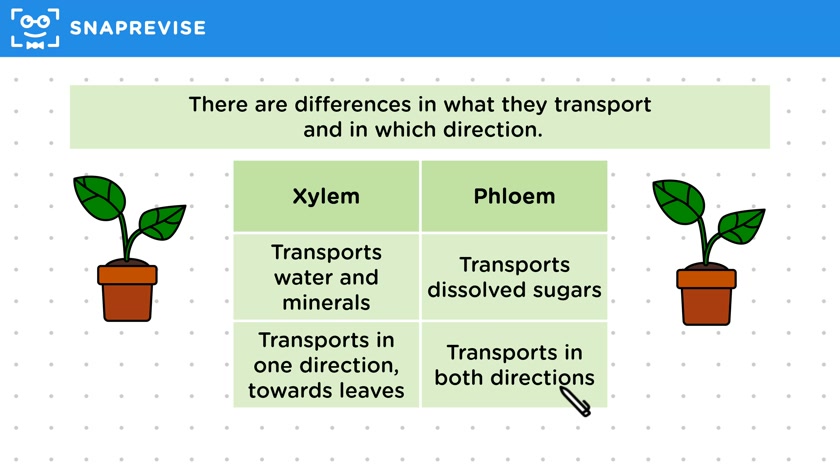
- Xylem and phloem differ in the substances they transport and the directions of transport.
- Xylem transports water and minerals upwards towards the leaves.
- Phloem transports dissolved sugars in both upward and downward directions.
- Xylem is composed of dead, elongated cells without cytoplasm, forming a continuous tube reinforced with lignin.
- Phloem consists of living, elongated cells with cytoplasm, connected by pores, and lacks structural reinforcement.
- Energy is not required for transport in xylem, whereas phloem needs energy from outer cells for sugar transport.
Please subscribe to access these revision notes.
This, and all other video notes, are included in our premium subscriptions.
Premium accounts get access to all videos and revision notes.
135
questions for Cell Biology
17
questions for Cell Structure