
GCSE Combined Science (AQA)
622 videos | 38 hours
Please subscribe to watch this video.
This, and all other videos, are included in our premium subscriptions.
Premium accounts get access to all videos.
Enable autoplay to keep watching
Your browser is blocking videos from playing automatically. To turn it back on:
Safari (Mac): Click the Safari menu item in the top bar, then Settings → Websites → Auto-Play, then set Auto-Play to Allow All Auto-Play for the current website.
Safari (iPhone/iPad): open the Settings app, then Apps → Safari → Auto-Play, and select Allow All Auto-Play.
Components in Parallel
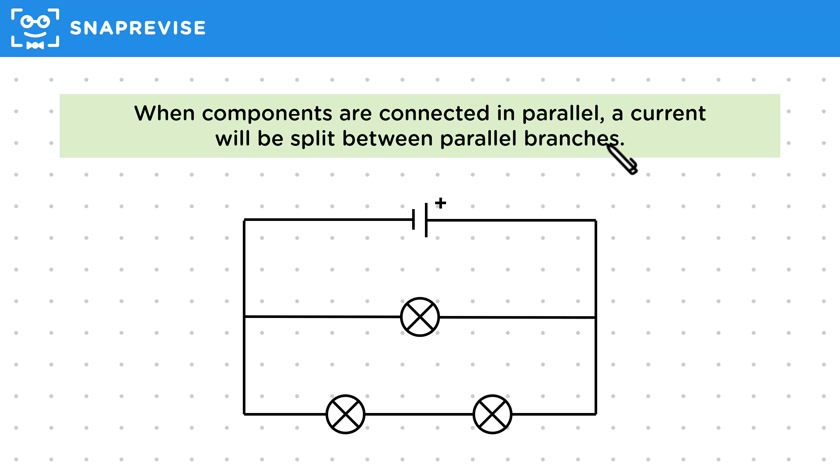
- Electrical components are in parallel if they are on separate branches of a circuit that run alongside each other.
- In parallel circuits, there is no path that goes through both components.
- Example: Two lamps on different branches are in parallel because there are two possible paths around the circuit.
- A circuit with branching paths where branches don't run alongside each other is not parallel.
- In parallel circuits, the current is split between parallel branches.
- Charge carriers (delocalized electrons) split at junctions to travel down different branches.
- Parallel lamps have different charge carriers flowing through them, meaning the current is split.
- If a component in a parallel circuit breaks, the current can still flow through other components.
- Example: If one lamp in a parallel circuit breaks, the other lamp can still function.
- Most real-life circuits, like house mains, are set up with parallel branches to ensure functionality if one component fails.
Please subscribe to access these revision notes.
This, and all other video notes, are included in our premium subscriptions.
Premium accounts get access to all videos and revision notes.
125
questions for Electricity
29
questions for Series and parallel circuits