
GCSE Combined Science (AQA)
622 videos | 38 hours
Please subscribe to watch this video.
This, and all other videos, are included in our premium subscriptions.
Premium accounts get access to all videos.
Enable autoplay to keep watching
Your browser is blocking videos from playing automatically. To turn it back on:
Safari (Mac): Click the Safari menu item in the top bar, then Settings → Websites → Auto-Play, then set Auto-Play to Allow All Auto-Play for the current website.
Safari (iPhone/iPad): open the Settings app, then Apps → Safari → Auto-Play, and select Allow All Auto-Play.
Crude Oil Fractional Distillation
- Crude oil is a mixture of different hydrocarbons.
- Hydrocarbons are molecules made of carbon and hydrogen.
- Crude oil contains both small and large hydrocarbon molecules.
- As hydrocarbon size increases, their boiling point increases.
- Fractional distillation is used to separate crude oil into fractions.
- Fractions contain molecules with a similar number of carbon atoms.
- Molecules in a fraction have similar properties and uses due to similar sizes and boiling points.
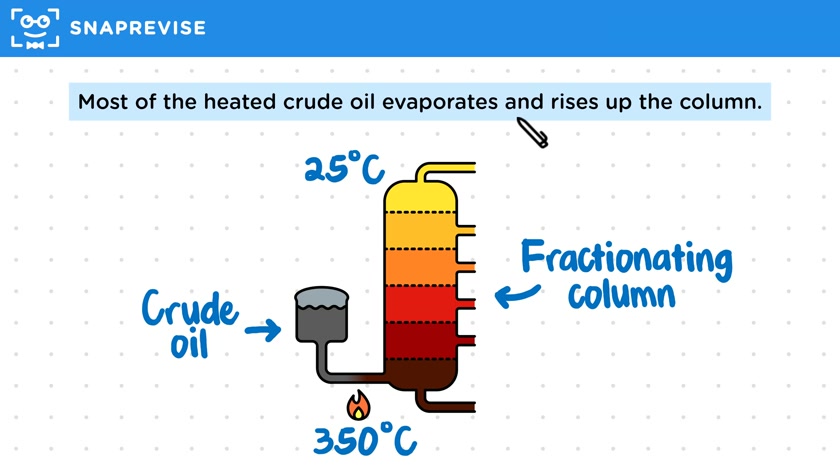
- Fractional distillation involves heating crude oil and using a fractionating column.
- The temperature in the column decreases with height.
- Heated crude oil enters the bottom of the column, evaporates, and rises.
- Hydrocarbons condense back into liquid at their boiling point and are collected.
- Smaller hydrocarbons have lower boiling points and condense higher up the column.
- Larger hydrocarbons are collected at the bottom of the column.
- Bitumen is a mixture of large hydrocarbons collected at the bottom.
- Larger hydrocarbons are used for heavy fuel oil and diesel.
- Smaller hydrocarbons are used for kerosene and petrol.
- The smallest hydrocarbons are extracted as gases and stored as liquified petroleum gases.
- Knowledge of the names of these products is required for exams.
Please subscribe to access these revision notes.
This, and all other video notes, are included in our premium subscriptions.
Premium accounts get access to all videos and revision notes.
31
questions for Organic chemistry
31
questions for Carbon compounds as fuels and feedstock