
GCSE Combined Science (AQA)
622 videos | 38 hours
Please subscribe to watch this video.
This, and all other videos, are included in our premium subscriptions.
Premium accounts get access to all videos.
Enable autoplay to keep watching
Your browser is blocking videos from playing automatically. To turn it back on:
Safari (Mac): Click the Safari menu item in the top bar, then Settings → Websites → Auto-Play, then set Auto-Play to Allow All Auto-Play for the current website.
Safari (iPhone/iPad): open the Settings app, then Apps → Safari → Auto-Play, and select Allow All Auto-Play.
Development of the Later Atomic Models
- The nuclear model of the atom has evolved over time based on experimental observations.
- The alpha scattering experiment revealed that almost all the mass and positive charge of an atom are in a central nucleus.
- The term "nuclear model" originates from this discovery.
- Initially, electrons were thought to be scattered around the empty space of the atom.
- Niels Bohr refined the model by proposing that electrons orbit the nucleus at specific distances, known as energy levels or shells.
- Bohr's theory predicted behaviors and calculations that matched experimental observations.
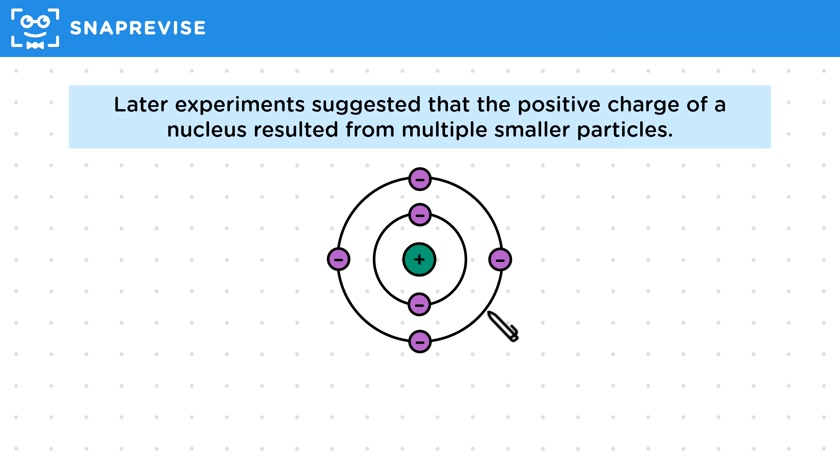
- Later experiments indicated that the nucleus's positive charge came from multiple smaller particles, not a single particle.
- These smaller particles were named protons, which are positively charged and heavier than electrons.
- James Chadwick's experiments discovered neutrons, particles in the nucleus with mass but no charge.
- Neutrons explained inconsistencies in atomic mass measurements without affecting the charge.
- The nuclear model with protons, electrons, and neutrons is the basis for current understanding and is used in GCSEs.
- The understanding of atomic structure continues to become more detailed and refined.
Please subscribe to access these revision notes.
This, and all other video notes, are included in our premium subscriptions.
Premium accounts get access to all videos and revision notes.
57
questions for Atomic structure and the periodic table
52
questions for A simple model of the atom, symbols, relative atomic mass, electronic charge and isotopes