
GCSE Combined Science (AQA)
622 videos | 38 hours
Please subscribe to watch this video.
This, and all other videos, are included in our premium subscriptions.
Premium accounts get access to all videos.
Enable autoplay to keep watching
Your browser is blocking videos from playing automatically. To turn it back on:
Safari (Mac): Click the Safari menu item in the top bar, then Settings → Websites → Auto-Play, then set Auto-Play to Allow All Auto-Play for the current website.
Safari (iPhone/iPad): open the Settings app, then Apps → Safari → Auto-Play, and select Allow All Auto-Play.
Development of the Periodic Table
- The periodic table has evolved as scientific methods and theories have developed.
- Initially, elements were arranged in order of atomic weights, not in a table format.
- Early attempts to organize elements were simpler and not as structured as the modern periodic table.
- Scientists initially arranged elements by atomic weight, now referred to as relative atomic mass.
- John Newland in the 1860s suggested arranging elements in columns of seven, observing that every eighth element had similar properties.
- Early periodic tables were incomplete due to unknown elements, leading to incorrect patterns and groupings.
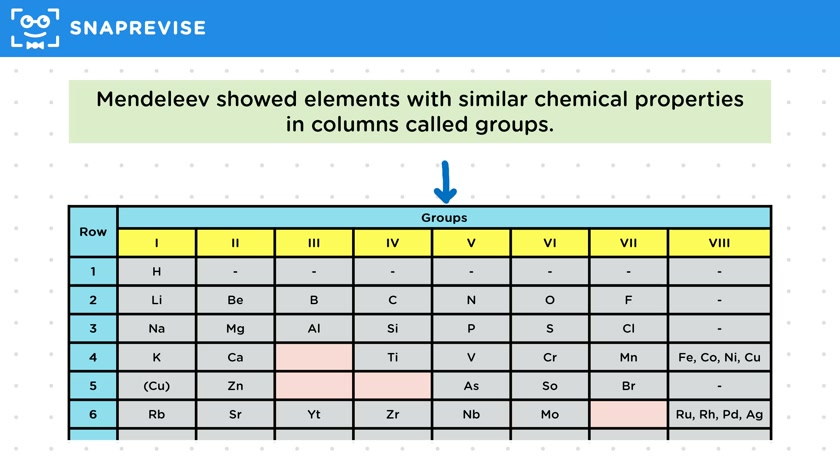
- Dmitri Mendeleev improved the periodic table by arranging elements with similar chemical properties in columns called groups.
- Mendeleev left gaps for undiscovered elements, predicting their properties, which were later confirmed with discoveries like germanium.
- Mendeleev swapped some elements out of atomic weight order to maintain consistent group properties.
- The discovery of isotopes explained why atomic weight order was not always correct.
- The modern periodic table is organized by increasing proton number, not atomic weight.
- Mendeleev's predictions about element relationships were validated with later scientific discoveries.
- Understanding the improvements Mendeleev made and subsequent developments is important for exams.
Please subscribe to access these revision notes.
This, and all other video notes, are included in our premium subscriptions.
Premium accounts get access to all videos and revision notes.
57
questions for Atomic structure and the periodic table
5
questions for The periodic table