
GCSE Combined Science (AQA)
622 videos | 38 hours
Please subscribe to watch this video.
This, and all other videos, are included in our premium subscriptions.
Premium accounts get access to all videos.
Enable autoplay to keep watching
Your browser is blocking videos from playing automatically. To turn it back on:
Safari (Mac): Click the Safari menu item in the top bar, then Settings → Websites → Auto-Play, then set Auto-Play to Allow All Auto-Play for the current website.
Safari (iPhone/iPad): open the Settings app, then Apps → Safari → Auto-Play, and select Allow All Auto-Play.
Energy Transferred by Charge
- Charge carriers in circuits transfer energy from a power source to electrical components.
- A cell supplies energy by doing work on charge carriers to give them kinetic energy.
- Energy is carried around the circuit through the kinetic energy of electrons.
- Work is done on components as charge carriers transfer energy to them.
- The process transfers chemical energy from the cell to the components.
- Energy used by an electrical appliance depends on its power and duration of use.
- Energy transferred equation: E = P x T (Energy = Power x Time).
- Energy is measured in joules, power in watts, and time in seconds.
- Longer use and higher power of an appliance result in more energy transfer.
- Higher power rating of a device means more energy transfer.
- Efficiency of appliances is important; switch off when not in use to save energy and money.
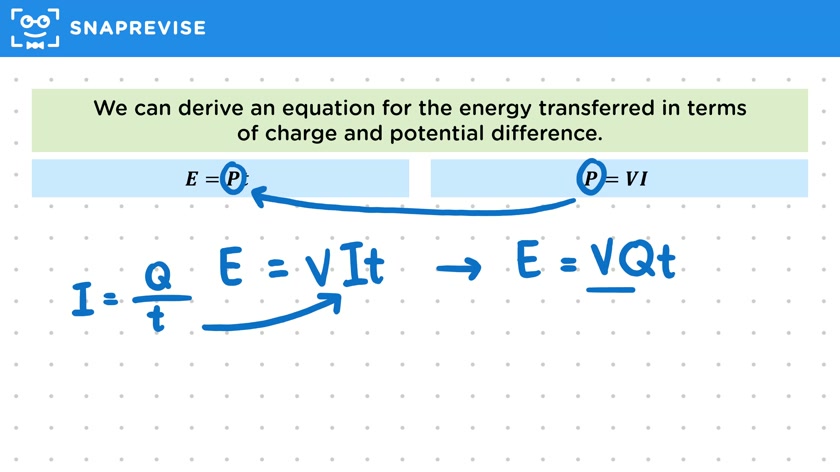
- Energy transferred can be calculated using charge and potential difference.
- Equation: E = V x Q (Energy = Potential Difference x Charge).
- Example calculation: Speaker uses 8 megajoules of energy at 230 volts.
- Calculate charge: Charge = Energy transferred / Potential difference.
- Example result: 35,000 coulombs of charge flow through the speaker during the concert.
Please subscribe to access these revision notes.
This, and all other video notes, are included in our premium subscriptions.
Premium accounts get access to all videos and revision notes.
125
questions for Electricity
28
questions for Energy transfers