
GCSE Combined Science (AQA)
622 videos | 38 hours
Please subscribe to watch this video.
This, and all other videos, are included in our premium subscriptions.
Premium accounts get access to all videos.
Enable autoplay to keep watching
Your browser is blocking videos from playing automatically. To turn it back on:
Safari (Mac): Click the Safari menu item in the top bar, then Settings → Websites → Auto-Play, then set Auto-Play to Allow All Auto-Play for the current website.
Safari (iPhone/iPad): open the Settings app, then Apps → Safari → Auto-Play, and select Allow All Auto-Play.
Family Trees
- Family trees display relationships and inheritance across generations, with the youngest members at the bottom.
- In biology, family trees illustrate the inheritance of traits over generations.
- Family trees in biology typically have the newest members at the bottom, progressing to the oldest at the top.
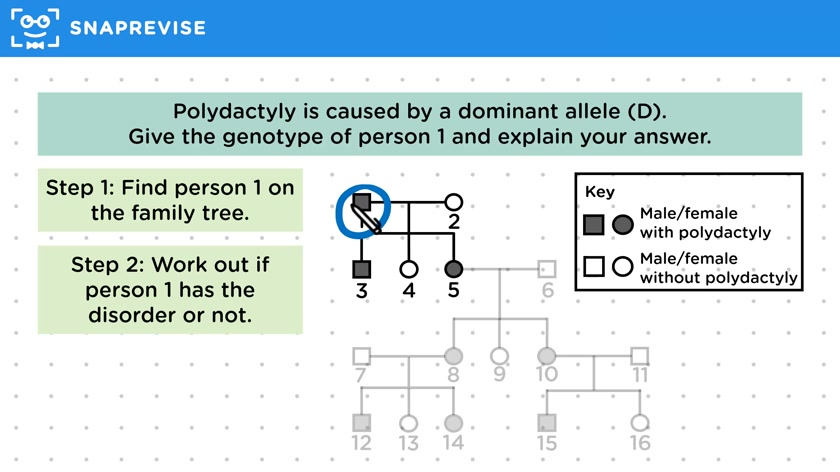
- Family trees use a key to indicate characteristics and gender: males with squares, females with circles, and traits like polydactyly shown by filled shapes.
- Polydactyly is a trait caused by a dominant allele (represented as "D").
- By analyzing a family tree, one can determine the genotype of individuals, such as identifying if a person has polydactyly (dominant allele present) or is homozygous recessive (both alleles recessive, indicated by absence of polydactyly).
- The example explains that person one has a genotype of "Dd" (heterozygous) because they have polydactyly and their child (person four) does not, indicating the presence of a recessive allele.
- Family trees help in predicting genetic traits and understanding the inheritance patterns within a family, useful for both academic studies and practical applications like genetic counseling.
Please subscribe to access these revision notes.
This, and all other video notes, are included in our premium subscriptions.
Premium accounts get access to all videos and revision notes.
81
questions for Inheritance, Variation and Evolution
16
questions for Reproduction