
GCSE Combined Science (AQA)
622 videos | 38 hours
Please subscribe to watch this video.
This, and all other videos, are included in our premium subscriptions.
Premium accounts get access to all videos.
Enable autoplay to keep watching
Your browser is blocking videos from playing automatically. To turn it back on:
Safari (Mac): Click the Safari menu item in the top bar, then Settings → Websites → Auto-Play, then set Auto-Play to Allow All Auto-Play for the current website.
Safari (iPhone/iPad): open the Settings app, then Apps → Safari → Auto-Play, and select Allow All Auto-Play.
Forces
Forces and their interactions
Free Body Diagram Calculations
2:47
Resultant Force
Spec
4.5.1.4
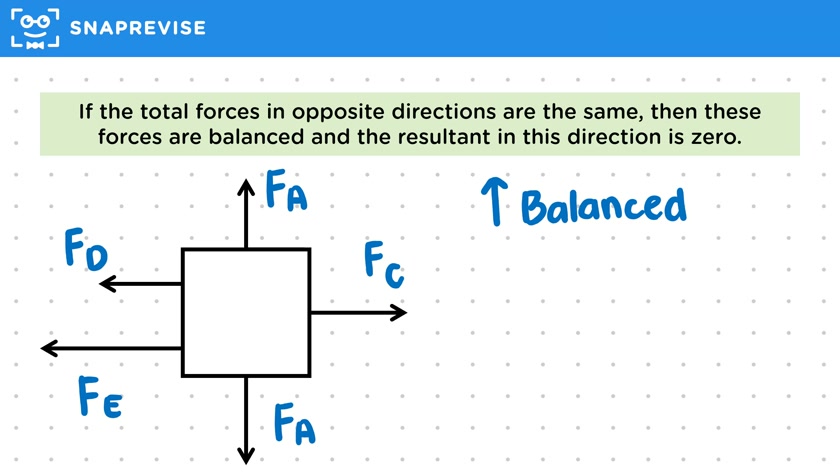
- Forces acting on an object that are perpendicular can be analyzed by separating horizontal and vertical forces.
- Perpendicular means forces are at right angles.
- Forces are represented as vectors in diagrams.
- Resultant force can be calculated separately in horizontal and vertical directions.
- In vertical direction, calculation involves subtraction (FA - fb).
- In horizontal direction, calculation involves addition and subtraction (FD + FE - fc).
- A scale diagram can be used to represent the resultant force in a single direction.
- In exams, resultant forces are typically found using diagrams, focusing on parallel forces.
- If forces in opposite directions are equal, they balance out, making the resultant force in that direction zero.
- Balanced forces result in a resultant force that has no component in the direction where forces are balanced.
- Example provided with a boat: vertical forces (weight and up thrust) are balanced, horizontal forces (driving force and drag) are not, resulting in a net force.
- Calculation for boat example: 1500 Newtons (driving force) minus 500 Newtons (drag) equals 1000 Newtons horizontally forward.
- The resultant force for the boat is 1000 Newtons forward, as vertical forces are balanced and horizontal forward force is greater than the opposing force.
Please subscribe to access these revision notes.
This, and all other video notes, are included in our premium subscriptions.
Premium accounts get access to all videos and revision notes.
Report an Issue
Spotted something wrong? Let us know and we'll take a look.