
GCSE Combined Science (AQA)
622 videos | 38 hours
Please subscribe to watch this video.
This, and all other videos, are included in our premium subscriptions.
Premium accounts get access to all videos.
Enable autoplay to keep watching
Your browser is blocking videos from playing automatically. To turn it back on:
Safari (Mac): Click the Safari menu item in the top bar, then Settings → Websites → Auto-Play, then set Auto-Play to Allow All Auto-Play for the current website.
Safari (iPhone/iPad): open the Settings app, then Apps → Safari → Auto-Play, and select Allow All Auto-Play.
Freezing & Melting
- Freezing is the process of a substance changing from a liquid state to a solid state.
- Example: Freezing water in an ice tray.
- Melting is the opposite process, where a substance changes from a solid state to a liquid state.
- Example: An ice lolly melting in the sun.
- You should be able to recognize and describe freezing and melting, especially with water.
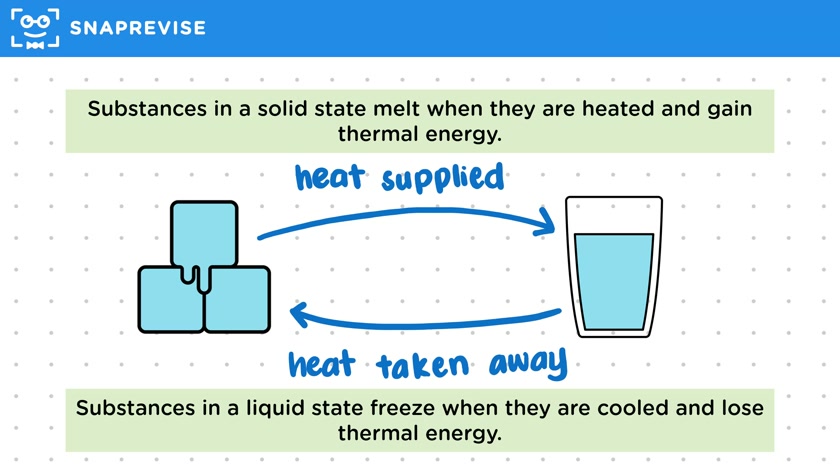
- Substances melt when heated and gain thermal energy.
- Ice and water are the same substance in different states; ice melts when heat is supplied.
- Substances freeze when cooled and lose thermal energy.
- Freezing and melting are caused by changes in thermal energy.
- The melting point is the temperature at which a substance will melt when heated.
- The melting point of water is 0 degrees Celsius, which helps define the Celsius scale.
- A change of state occurs when temperature crosses the melting point.
- Different substances have different melting points.
- Example: Oil's melting point is approximately -20 degrees C; steel's is approximately 1,510 degrees C.
- Oil is a liquid at room temperature, while steel is a solid due to their melting points.
- You need to know the melting point of water for exams, but not other substances' melting points unless given.
Please subscribe to access these revision notes.
This, and all other video notes, are included in our premium subscriptions.
Premium accounts get access to all videos and revision notes.
89
questions for Particle model of matter
34
questions for Changes of state and the particle model