
GCSE Combined Science (AQA)
622 videos | 38 hours
Please subscribe to watch this video.
This, and all other videos, are included in our premium subscriptions.
Premium accounts get access to all videos.
Enable autoplay to keep watching
Your browser is blocking videos from playing automatically. To turn it back on:
Safari (Mac): Click the Safari menu item in the top bar, then Settings → Websites → Auto-Play, then set Auto-Play to Allow All Auto-Play for the current website.
Safari (iPhone/iPad): open the Settings app, then Apps → Safari → Auto-Play, and select Allow All Auto-Play.
Genetic Crosses & Probability
- Genetic crosses occur through sexual reproduction, creating new combinations of alleles.
- Crossing chromosomes can result in different combinations of alleles.
- Dominant alleles are represented by uppercase letters, while recessive alleles are shown with lowercase letters.
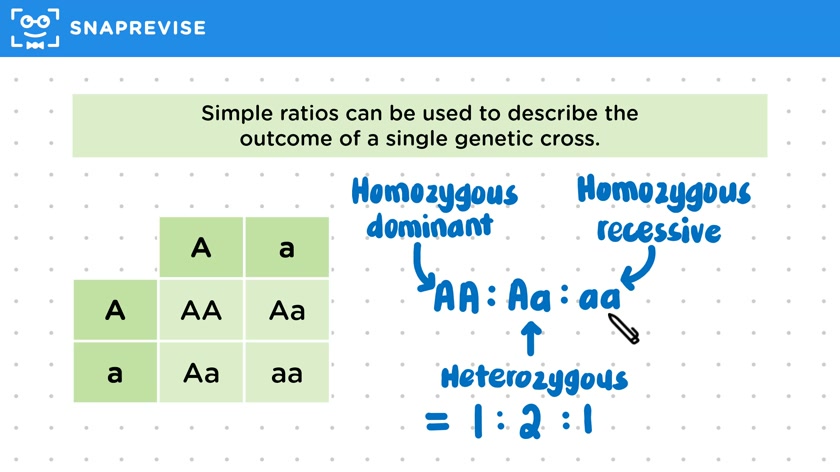
- Punnet square diagrams are used to predict possible genotypes of offspring from two parents.
- Example given with both parents heterozygous for a single gene (Aa x Aa).
- Four possible combinations for offspring: AA, Aa, aA, aa.
- Three possible genotypes for offspring: homozygous dominant (AA), heterozygous (Aa), and homozygous recessive (aa).
- Each child has a probability of having one of these three genotypes.
- Genotype ratios from a Punnet square can be expressed as 1:2:1 for AA:Aa:aa.
- Probabilities can also be expressed as fractions or percentages: 25% AA, 50% Aa, 25% aa.
- Understanding and interpreting Punnet squares is crucial for genetics exams.
- Real-life example: calculating probabilities of eye color (brown dominant, blue recessive) using Punnet squares.
- Parents with genotypes Bb (brown eyes, heterozygous) and bb (blue eyes, homozygous recessive) can produce offspring with a 50% chance of having blue eyes.
Please subscribe to access these revision notes.
This, and all other video notes, are included in our premium subscriptions.
Premium accounts get access to all videos and revision notes.
81
questions for Inheritance, Variation and Evolution
16
questions for Reproduction