
GCSE Combined Science (AQA)
622 videos | 38 hours
Please subscribe to watch this video.
This, and all other videos, are included in our premium subscriptions.
Premium accounts get access to all videos.
Enable autoplay to keep watching
Your browser is blocking videos from playing automatically. To turn it back on:
Safari (Mac): Click the Safari menu item in the top bar, then Settings → Websites → Auto-Play, then set Auto-Play to Allow All Auto-Play for the current website.
Safari (iPhone/iPad): open the Settings app, then Apps → Safari → Auto-Play, and select Allow All Auto-Play.
Group 0: Noble Gases
- Group zero elements are non-metals found in the last column of the periodic table.
- Group zero elements are called noble gases.
- Noble gases are unreactive or inert.
- Argon is used in filament bulbs due to its non-reactivity.
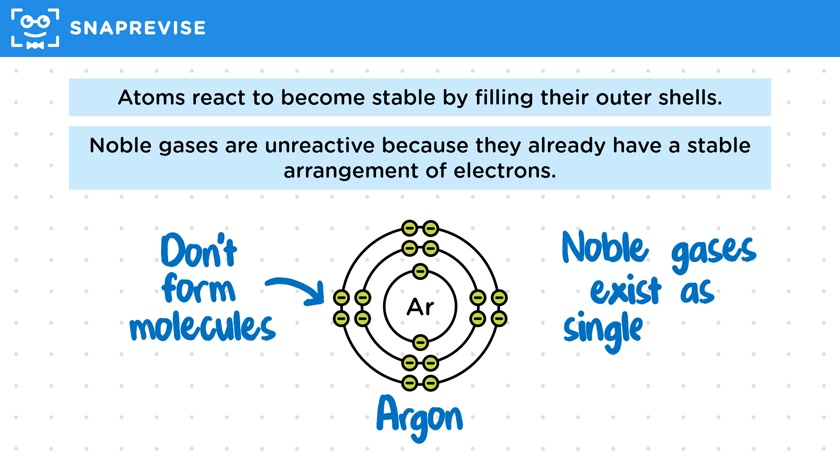
- Noble gases have full outer shells, making them stable and unreactive.
- Helium has two electrons in its outer shell, while other noble gases have eight.
- Noble gases exist as single atoms, not molecules.
- Relative atomic mass increases down group zero.
- Boiling points of noble gases increase down the group.
- Larger mass and size of atoms result in stronger intermolecular forces, requiring more energy to overcome.
- The further down the group, the higher the relative atomic mass, melting, and boiling points.
- Properties can be predicted from trends down a group.
- Boiling points can be estimated by observing trends, such as a 30 to 50-degree increase between elements.
Please subscribe to access these revision notes.
This, and all other video notes, are included in our premium subscriptions.
Premium accounts get access to all videos and revision notes.
57
questions for Atomic structure and the periodic table
5
questions for The periodic table