
GCSE Combined Science (AQA)
622 videos | 38 hours
Please subscribe to watch this video.
This, and all other videos, are included in our premium subscriptions.
Premium accounts get access to all videos.
Enable autoplay to keep watching
Your browser is blocking videos from playing automatically. To turn it back on:
Safari (Mac): Click the Safari menu item in the top bar, then Settings → Websites → Auto-Play, then set Auto-Play to Allow All Auto-Play for the current website.
Safari (iPhone/iPad): open the Settings app, then Apps → Safari → Auto-Play, and select Allow All Auto-Play.
Group 1: Reaction with Oxygen
- Alkali metals react with oxygen to form metal oxides.
- The reaction is represented as metal + oxygen ��� metal oxide.
- A gray block of alkali metal reacts with air oxygen, forming a white metal oxide coating.
- Reactivity with oxygen increases down the group of alkali metals.
- Lithium is the least reactive, while francium is the most reactive with oxygen.
- Alkali metals react with oxygen at room temperature, but only the surface reacts.
- Cutting into alkali metals shows a shiny interior, indicating only the surface reacts.
- Metals are stored in oil to prevent tarnishing by stopping oxygen exposure.
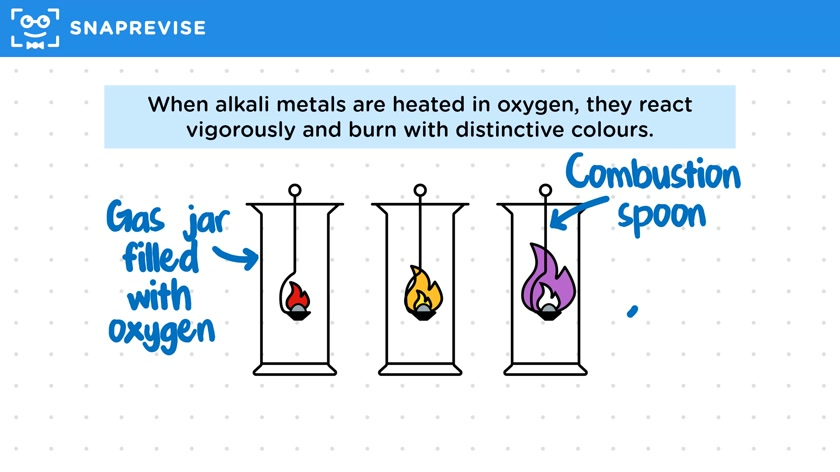
- When heated in oxygen, alkali metals burn with distinctive colors.
- Lithium burns with a red flame, sodium with a yellow flame, and potassium with a lilac flame.
- Lithium reaction: lithium + oxygen ��� lithium oxide; balanced equation: 4Li + O2 ��� 2Li2O.
- Sodium reaction: sodium + oxygen ��� sodium oxide; balanced equation: 4Na + O2 ��� 2Na2O.
- Potassium reaction: potassium + oxygen ��� potassium oxide; balanced equation: 4K + O2 ��� 2K2O.
Please subscribe to access these revision notes.
This, and all other video notes, are included in our premium subscriptions.
Premium accounts get access to all videos and revision notes.
57
questions for Atomic structure and the periodic table
5
questions for The periodic table