
GCSE Combined Science (AQA)
622 videos | 38 hours
Please subscribe to watch this video.
This, and all other videos, are included in our premium subscriptions.
Premium accounts get access to all videos.
Enable autoplay to keep watching
Your browser is blocking videos from playing automatically. To turn it back on:
Safari (Mac): Click the Safari menu item in the top bar, then Settings → Websites → Auto-Play, then set Auto-Play to Allow All Auto-Play for the current website.
Safari (iPhone/iPad): open the Settings app, then Apps → Safari → Auto-Play, and select Allow All Auto-Play.
Group 1: Reaction with Water
- All alkaline metals react vigorously with water.
- Cesium, the most reactive alkaline metal, reacts violently with water, producing a flame and potentially shattering the glass container.
- Cesium has the chemical symbol Cs.
- Reactivity increases down the group, making reactions with water more violent.
- Alkaline metals reacting with water produce a metal hydroxide and hydrogen.
- The general word equation: metal + water ��� metal hydroxide + hydrogen.
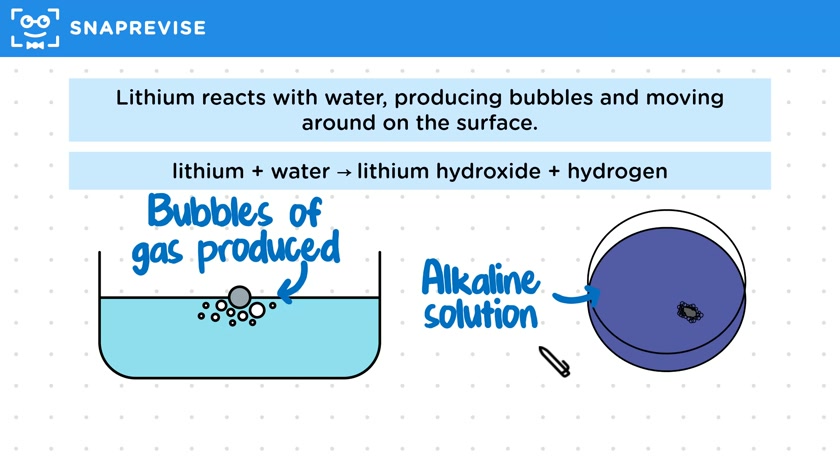
- Example: Lithium + water ��� lithium hydroxide + hydrogen.
- Metal hydroxides are bases and dissolve in water to form an alkaline solution.
- Universal indicator in water changes color to show pH: green for neutral, purple for alkaline.
- Lithium reacts with water, producing bubbles and moving on the surface.
- Sodium reacts quickly with water, producing a yellow-orange flame and more rapid hydrogen bubbles.
- Potassium reacts vigorously, producing a lilac flame and vigorous hydrogen bubbles.
- The trend down the group can predict reactions: rubidium will bubble violently, and cesium will likely explode with water.
- Balanced chemical equations for reactions with water:
- Lithium: 2Li + 2H2O ��� 2LiOH + H2
- Sodium: 2Na + 2H2O ��� 2NaOH + H2
- Potassium: 2K + 2H2O ��� 2KOH + H2
- Using data to predict reactions is a necessary skill for exams.
Please subscribe to access these revision notes.
This, and all other video notes, are included in our premium subscriptions.
Premium accounts get access to all videos and revision notes.
57
questions for Atomic structure and the periodic table
5
questions for The periodic table