
GCSE Combined Science (AQA)
622 videos | 38 hours
Please subscribe to watch this video.
This, and all other videos, are included in our premium subscriptions.
Premium accounts get access to all videos.
Enable autoplay to keep watching
Your browser is blocking videos from playing automatically. To turn it back on:
Safari (Mac): Click the Safari menu item in the top bar, then Settings → Websites → Auto-Play, then set Auto-Play to Allow All Auto-Play for the current website.
Safari (iPhone/iPad): open the Settings app, then Apps → Safari → Auto-Play, and select Allow All Auto-Play.
Half Equations
- Half equations represent reactions at electrodes during electrolysis.
- Electrolysis separates molten or aqueous ions.
- Half equations show ions gaining or losing electrons to become atoms or molecules.
- Negative ions move to the positive electrode (anode), positive ions to the negative electrode (cathode).
- Negative ions have excess electrons; positive ions lack electrons.
- Exchange of electrons neutralizes ion charges, forming neutral atoms.
- Example: Electrolysis of aluminum oxide forms aluminum at the cathode.
- Aluminum ions gain electrons at the cathode, forming aluminum atoms.
- Half equation: Al����� + 3e��� ��� Al.
- Reduction is gain of electrons (OIL RIG: Oxidation is loss, reduction is gain).
- Electrons must be on the left with positive ions in half equations.
- Non-metal forms at the anode; oxygen ions become oxygen atoms.
- Oxygen atoms exist as diatomic molecules; need two ions for one molecule.
- Half equation for oxygen: 2O����� ��� O��� + 4e���.
- Oxidation is loss of electrons; oxygen ions lose electrons.
- In aqueous solutions, if metal is more reactive than hydrogen, hydrogen forms at the cathode.
- Water molecules break down, releasing hydrogen ions.
- Reactivity series determines if hydrogen or metal forms at cathode.
- Example: Zinc is more reactive than hydrogen; hydrogen gas forms at cathode.
- Half equation for hydrogen: 2H��� + 2e��� ��� H���.
- If metal is less reactive than hydrogen, metal forms at cathode.
- Example: Copper is less reactive; copper forms at cathode.
- Half equation for copper: Cu����� + 2e��� ��� Cu.
- Halide ions produce halogen gases at anode.
- Example: Iodide ions form iodine gas at anode.
- Half equation for iodine: 2I��� ��� I��� + 2e���.
- Without halide ions, oxygen and water form at anode.
- Hydroxide ions lose electrons, forming oxygen and water.
- Half equation for hydroxide: 4OH��� ��� O��� + 2H���O + 4e���.
- Predict reactions and deduce half equations for exams.
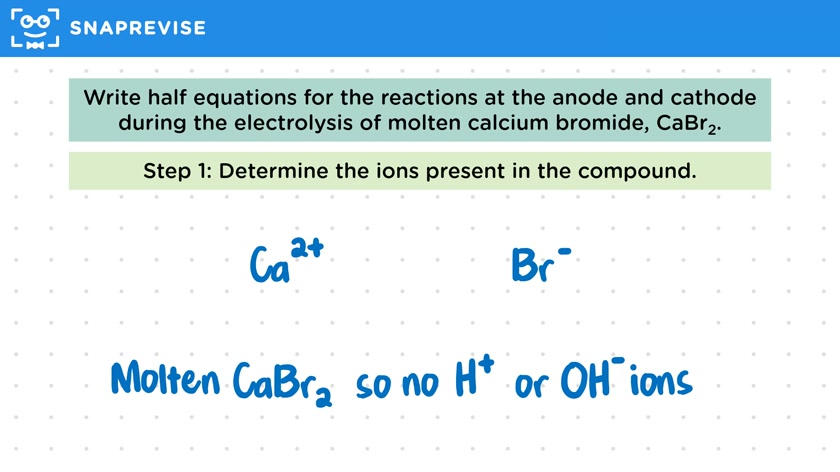
- Example: Electrolysis of molten calcium bromide.
- Calcium ions form calcium at cathode; bromide ions form bromine at anode.
- Half equation for bromine: 2Br��� ��� Br��� + 2e���.
- Half equation for calcium: Ca����� + 2e��� ��� Ca.
- Example: Electrolysis of magnesium nitrate solution.
- Hydroxide ions form oxygen and water at anode.
- Hydrogen ions form hydrogen gas at cathode.
- Half equation for hydroxide: 4OH��� ��� O��� + 2H���O + 4e���.
- Half equation for hydrogen: 2H��� + 2e��� ��� H���.
Please subscribe to access these revision notes.
This, and all other video notes, are included in our premium subscriptions.
Premium accounts get access to all videos and revision notes.
72
questions for Chemical changes
21
questions for Electrolysis