
GCSE Combined Science (AQA)
622 videos | 38 hours
Please subscribe to watch this video.
This, and all other videos, are included in our premium subscriptions.
Premium accounts get access to all videos.
Enable autoplay to keep watching
Your browser is blocking videos from playing automatically. To turn it back on:
Safari (Mac): Click the Safari menu item in the top bar, then Settings → Websites → Auto-Play, then set Auto-Play to Allow All Auto-Play for the current website.
Safari (iPhone/iPad): open the Settings app, then Apps → Safari → Auto-Play, and select Allow All Auto-Play.
Half-Life Calculations
- Determine the ratio of nuclei left in a sample using the number of half-lives passed.
- Half-life is the time for the number of nuclei or activity to halve.
- Proportion of nuclei remaining is found by halving the number of nuclei after each half-life.
- Example proportions:
- After 1 half-life: 1/2 remain
- After 2 half-lives: 1/4 remain
- After 3 half-lives: 1/8 remain
- After 4 half-lives: 1/16 remain
- After 5 half-lives: 1/32 remain
- This proportion is consistent for any sample size.
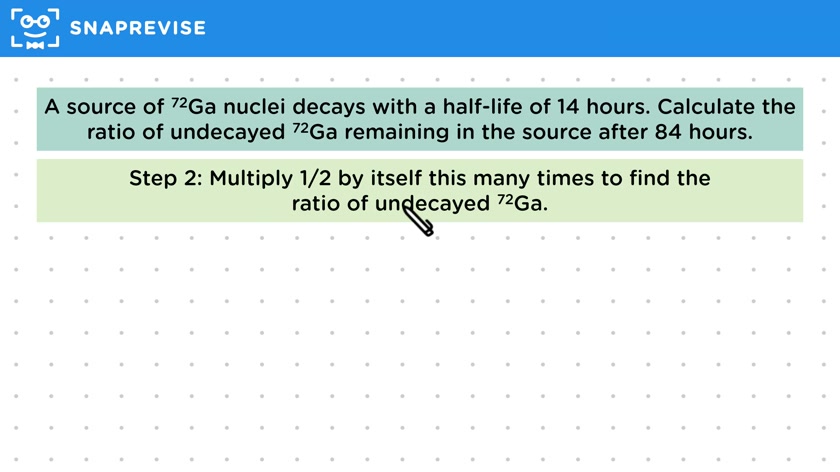
- Example: 72 gallium nuclei with a half-life of 14 hours.
- Calculate ratio after 84 hours.
- Step 1: Calculate number of half-lives (84 hours / 14 hours = 6 half-lives).
- Step 2: Multiply half by itself 6 times (1/64 remain).
- Example: Carbon 14 isotope decay.
- Half-life of carbon 14 is 5,700 years.
- Calculate age of a bone sample with carbon 14 activity 1/8 of a living bone.
- Step 1: Calculate number of half-lives (1/8 = 3 half-lives).
- Step 2: Calculate age (3 half-lives x 5,700 years = 17,100 years).
Please subscribe to access these revision notes.
This, and all other video notes, are included in our premium subscriptions.
Premium accounts get access to all videos and revision notes.
111
questions for Atomic structure
71
questions for Atoms and nuclear radiation