
GCSE Combined Science (AQA)
622 videos | 38 hours
Please subscribe to watch this video.
This, and all other videos, are included in our premium subscriptions.
Premium accounts get access to all videos.
Enable autoplay to keep watching
Your browser is blocking videos from playing automatically. To turn it back on:
Safari (Mac): Click the Safari menu item in the top bar, then Settings → Websites → Auto-Play, then set Auto-Play to Allow All Auto-Play for the current website.
Safari (iPhone/iPad): open the Settings app, then Apps → Safari → Auto-Play, and select Allow All Auto-Play.
Inertial Mass
- Inertia is the tendency of an object to remain in a state of rest or uniform motion.
- State of rest means an object that's not moving.
- Uniform motion means an object isn't changing its velocity.
- Inertia is derived from Latin for inactivity.
- Example of inertial motion: a shuttle drifting in space with no forces acting on it, moving at a constant velocity.
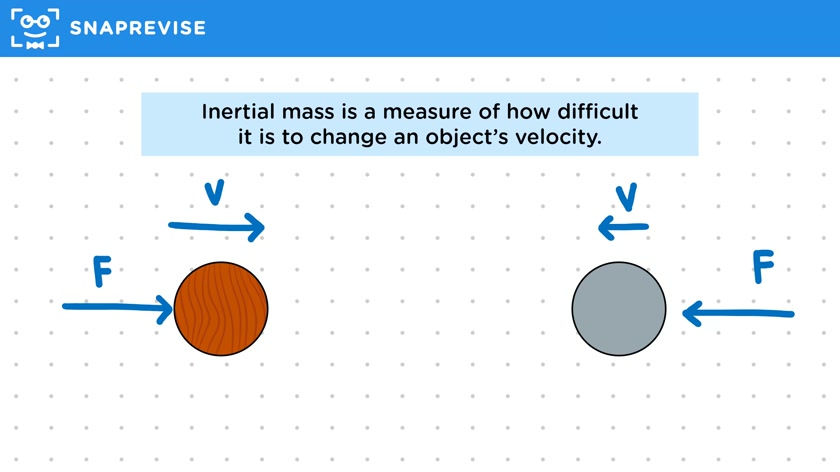
- Inertial mass measures how difficult it is to change an object's velocity.
- Important to define both inertia and inertial mass for exams.
- Example: two stationary balls (wood and metal) in space with no forces acting on them.
- Applying the same force to both balls results in less change in velocity for the metal ball, indicating greater inertial mass.
- Inertial mass can be described mathematically using Newton's second law.
- Newton's second law: acceleration is proportional to the resultant force and inversely proportional to mass.
- Resultant force equals mass times acceleration.
- Inertial mass equals force divided by acceleration.
- Metal ball has greater inertial mass, resulting in smaller acceleration by the same force.
- Inertial mass is an application of mass, not a separate measurement.
- Equation for inertial mass is similar to Newton's second law and is used for explanation rather than calculations.
Please subscribe to access these revision notes.
This, and all other video notes, are included in our premium subscriptions.
Premium accounts get access to all videos and revision notes.
114
questions for Forces
95
questions for Forces and motion