
GCSE Combined Science (AQA)
622 videos | 38 hours
Please subscribe to watch this video.
This, and all other videos, are included in our premium subscriptions.
Premium accounts get access to all videos.
Enable autoplay to keep watching
Your browser is blocking videos from playing automatically. To turn it back on:
Safari (Mac): Click the Safari menu item in the top bar, then Settings → Websites → Auto-Play, then set Auto-Play to Allow All Auto-Play for the current website.
Safari (iPhone/iPad): open the Settings app, then Apps → Safari → Auto-Play, and select Allow All Auto-Play.
Ionic Bonding Diagrams
- Electron transfer during ionic compound formation can be visually represented.
- Use dots and crosses to represent electrons in electronic structures of metals and non-metals.
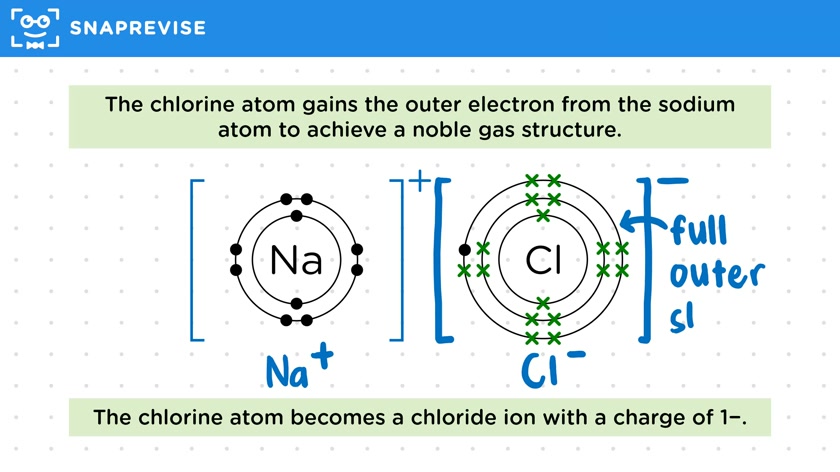
- Sodium (Na) electrons are shown as black dots; chlorine (Cl) electrons as green crosses.
- Dots and cross diagrams are used to represent ionic compounds.
- Sodium has an electron configuration of 2, 8, 1.
- Chlorine has an electron configuration of 2, 8, 7.
- Sodium transfers its outer electron to chlorine to achieve a noble gas structure.
- Sodium becomes a Na+ ion with a full outer shell (2, 8).
- Chlorine becomes a Cl- ion with a full outer shell (2, 8, 8).
- The ion formed from chlorine is called a chloride ion (Cl-).
- The reaction can be shown using dot and cross diagrams.
- Example: Magnesium (Mg) reacts with oxygen (O) to form magnesium oxide (MgO).
- Magnesium has an electron configuration of 2, 8, 2.
- Oxygen has an electron configuration of 2, 6.
- Magnesium loses two electrons, becoming Mg2+.
- Oxygen gains two electrons, becoming O2-.
- Both ions achieve a stable full outer shell configuration (2, 8).
- The complete reaction can be represented with dot and cross diagrams showing electron transfer.
Please subscribe to access these revision notes.
This, and all other video notes, are included in our premium subscriptions.
Premium accounts get access to all videos and revision notes.
28
questions for Bonding, structure, and the properties of matter
13
questions for Chemical bonds, ionic, covalent and metallic