
GCSE Combined Science (AQA)
622 videos | 38 hours
Please subscribe to watch this video.
This, and all other videos, are included in our premium subscriptions.
Premium accounts get access to all videos.
Enable autoplay to keep watching
Your browser is blocking videos from playing automatically. To turn it back on:
Safari (Mac): Click the Safari menu item in the top bar, then Settings → Websites → Auto-Play, then set Auto-Play to Allow All Auto-Play for the current website.
Safari (iPhone/iPad): open the Settings app, then Apps → Safari → Auto-Play, and select Allow All Auto-Play.
Kinetic & GPE Conversions
- When an object is thrown upwards, kinetic energy (KE) is converted to gravitational potential energy (GPE).
- As a ball gains height, work is done against gravity, converting KE to GPE, causing the ball to lose speed and gain height.
- When an object falls, GPE is converted back to KE, increasing speed and decreasing height.
- Assuming no energy loss to surroundings, the change in GPE equals the change in KE.
- Resistive forces cause energy loss to heat, leading to terminal speed.
- Without resistive forces, the change in KE equals the change in GPE (EK = EP).
- KE is calculated as 1/2 MV�� and GPE as MGH.
- Near the planet's surface, 1/2 MV�� = MGH, and masses can be canceled out to simplify.
- This equation is a starting point for solving harder problems.
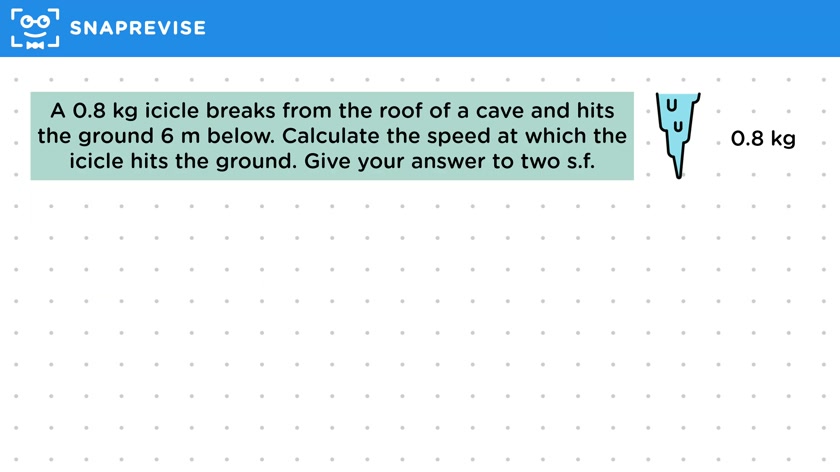
- Example: A 0.8 kg icicle falls 6 meters; calculate its speed upon hitting the ground.
- Key information: mass = 0.8 kg, height = 6 m, gravitational field strength = 9.8 m/s��.
- Calculate initial GPE: GPE = mass �� gravitational field strength �� height = 47.04 joules.
- Rearrange KE equation to solve for speed: V�� = 2EK/M.
- Substitute GPE for KE to find speed: V = ���(2EP/M).
- Calculate speed: V = ���(2 �� 47.04 J / 0.8 kg) = 10.8443 m/s.
- Round speed to two significant figures: 11 m/s.
Please subscribe to access these revision notes.
This, and all other video notes, are included in our premium subscriptions.
Premium accounts get access to all videos and revision notes.
114
questions for Forces
3
questions for Work done and energy transfer