
GCSE Combined Science (AQA)
622 videos | 38 hours
Please subscribe to watch this video.
This, and all other videos, are included in our premium subscriptions.
Premium accounts get access to all videos.
Enable autoplay to keep watching
Your browser is blocking videos from playing automatically. To turn it back on:
Safari (Mac): Click the Safari menu item in the top bar, then Settings → Websites → Auto-Play, then set Auto-Play to Allow All Auto-Play for the current website.
Safari (iPhone/iPad): open the Settings app, then Apps → Safari → Auto-Play, and select Allow All Auto-Play.
Limitations of the Particle Model
- The particle model helps understand the arrangement of particles in different states of matter.
- Particles are represented by small circles with different layouts for solids, liquids, and gases.
- Solids have regularly arranged circles, liquids have slightly more chaotic circles, and gases have circles far apart, moving rapidly.
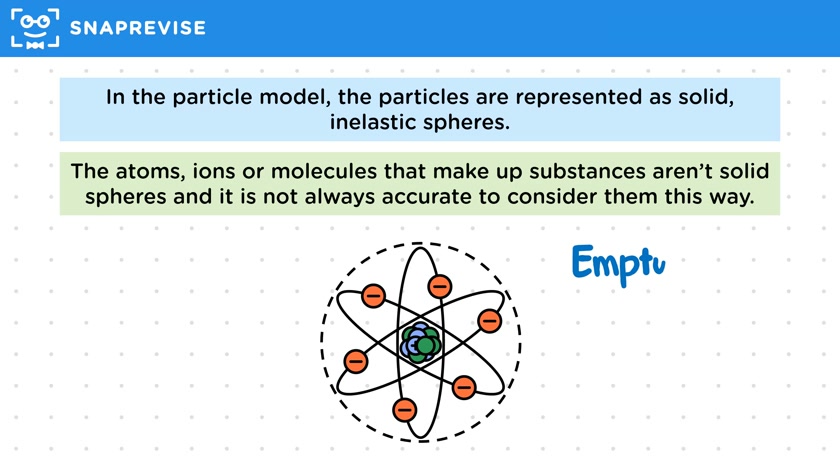
- The particle model has limitations, such as representing particles as solid inelastic spheres.
- Atoms, ions, or molecules aren't solid spheres, and the model doesn't accurately represent them.
- Particles are more complex with empty space and are made up of other particles.
- The particle model does not show forces between particles.
- Forces between particles vary depending on the substance and its structure.
- Different substances like salt, iron, and graphite have different structures and bonding, affecting particle interaction.
- These differences are not considered when looking at changes between different states of matter.
Please subscribe to access these revision notes.
This, and all other video notes, are included in our premium subscriptions.
Premium accounts get access to all videos and revision notes.
28
questions for Bonding, structure, and the properties of matter
11
questions for How bonding and structure are related to the properties of substances