
GCSE Combined Science (AQA)
622 videos | 38 hours
Please subscribe to watch this video.
This, and all other videos, are included in our premium subscriptions.
Premium accounts get access to all videos.
Enable autoplay to keep watching
Your browser is blocking videos from playing automatically. To turn it back on:
Safari (Mac): Click the Safari menu item in the top bar, then Settings → Websites → Auto-Play, then set Auto-Play to Allow All Auto-Play for the current website.
Safari (iPhone/iPad): open the Settings app, then Apps → Safari → Auto-Play, and select Allow All Auto-Play.
Lung Anatomy
- The lungs are organs involved in gas exchange and are part of the respiratory system.
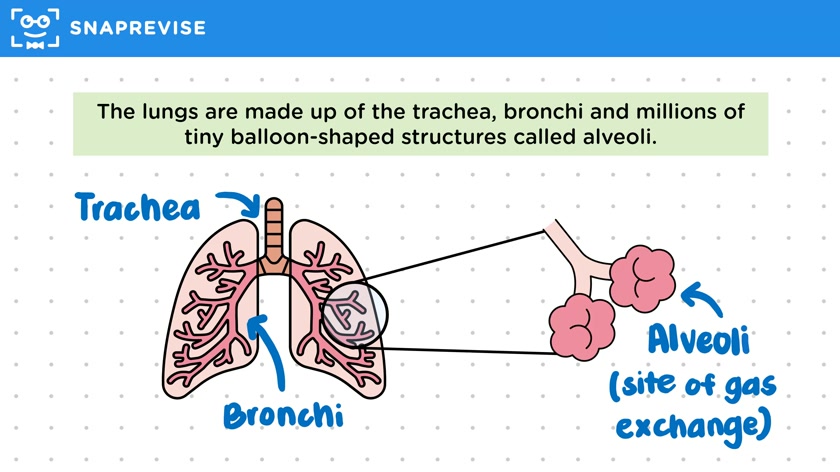
- A simple diagram illustrates the basic appearance of the lungs.
- The lungs consist of the trachea, bronchi, and millions of tiny balloon-shaped structures called alveoli.
- Alveoli provide a large surface area relative to the volume of the lungs, facilitating gas exchange.
- The estimated surface area of the lungs is about half the size of a tennis court.
- For exams, it is crucial to memorize the structure of the lungs and understand how they and the alveoli are adapted for material exchange by diffusion.
- Alveoli adaptations include good ventilation, a large surface area to volume ratio with folded walls to increase this area, and a large capillary network to maintain concentration gradients through continuous blood flow.
- Both alveoli and capillaries have thin, one-cell-thick membranes that enhance the rate of diffusion, allowing fast movement of substances necessary for respiration and quick removal of waste products.
Please subscribe to access these revision notes.
This, and all other video notes, are included in our premium subscriptions.
Premium accounts get access to all videos and revision notes.
55
questions for Organisation
47
questions for Animal Tissues, Organs and Organ Systems