
GCSE Combined Science (AQA)
622 videos | 38 hours
Please subscribe to watch this video.
This, and all other videos, are included in our premium subscriptions.
Premium accounts get access to all videos.
Enable autoplay to keep watching
Your browser is blocking videos from playing automatically. To turn it back on:
Safari (Mac): Click the Safari menu item in the top bar, then Settings → Websites → Auto-Play, then set Auto-Play to Allow All Auto-Play for the current website.
Safari (iPhone/iPad): open the Settings app, then Apps → Safari → Auto-Play, and select Allow All Auto-Play.
Magnification
- Magnification is the size of an image relative to the actual size of the object.
- A magnifying glass can enlarge the image of an object, such as in a Petri dish, without changing the object's actual size.
- High magnification allows us to see details invisible to the naked eye.
- Resolution is defined as the smallest distance between two points that can be distinguished as separate entities.
- High resolution provides more detail in images, whereas low resolution results in less clarity and detail.
- Microscopes are used to magnify objects like cells, tissue samples, and small insects for detailed observation.
- Different microscopes have varying resolutions.
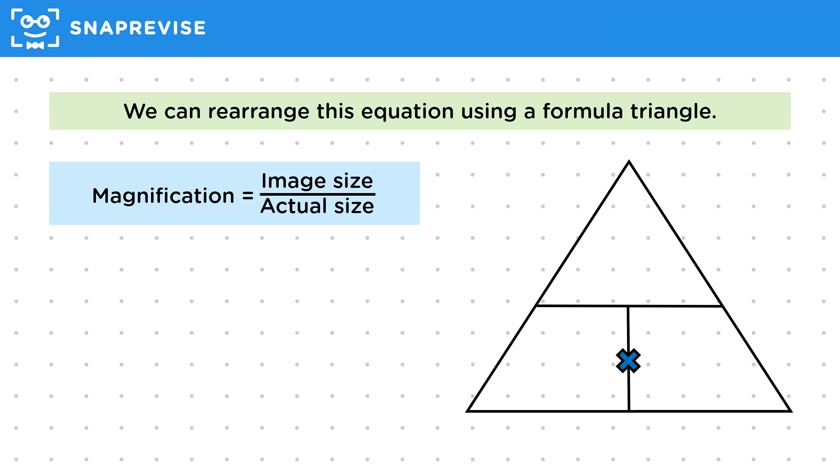
- The magnification equation is: magnification = image size / actual size.
- Example: An ant appears 50mm under a microscope but is actually 5mm; it is magnified, not resized.
- The magnification equation can be rearranged using a formula triangle to solve for missing values (image size, actual size, or magnification).
- Units for image size and actual size must be consistent (e.g., both in millimeters or micrometers) for calculations.
- Magnification is a unitless ratio, indicating how many times an image is enlarged compared to its actual size.
- Practical application example: To find the magnification of a cell, convert all measurements to the same unit, then apply the magnification equation.
- Conversion between different metric units (centi, milli, micro, nano) is essential for accurate calculations in exams.
Please subscribe to access these revision notes.
This, and all other video notes, are included in our premium subscriptions.
Premium accounts get access to all videos and revision notes.
135
questions for Cell Biology
17
questions for Cell Structure