
GCSE Combined Science (AQA)
622 videos | 38 hours
Please subscribe to watch this video.
This, and all other videos, are included in our premium subscriptions.
Premium accounts get access to all videos.
Enable autoplay to keep watching
Your browser is blocking videos from playing automatically. To turn it back on:
Safari (Mac): Click the Safari menu item in the top bar, then Settings → Websites → Auto-Play, then set Auto-Play to Allow All Auto-Play for the current website.
Safari (iPhone/iPad): open the Settings app, then Apps → Safari → Auto-Play, and select Allow All Auto-Play.
Magnification Calculations
- An equation is used to calculate the magnification of an image.
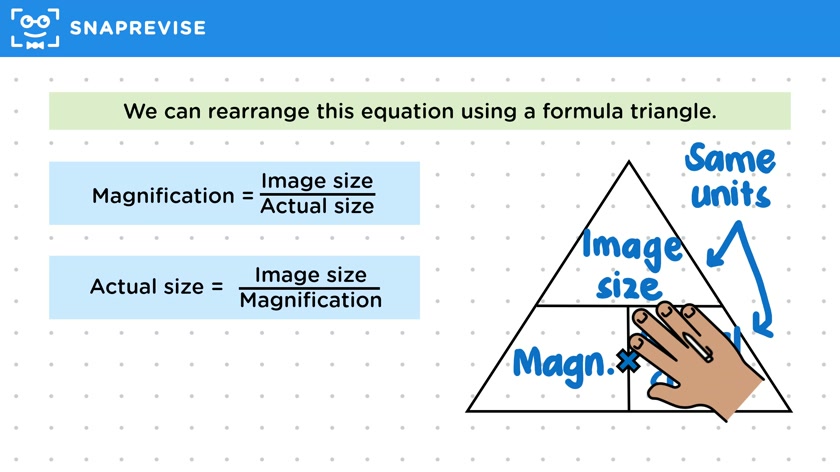
- Magnification is defined as the image size divided by the actual size.
- Example given: an ant viewed under a microscope has an image size of 50 millimeters and an actual size of 5 millimeters.
- The equation can be rearranged using a formula triangle to solve for missing values (image size, actual size, or magnification).
- Units for image size and actual size must be consistent (e.g., both in millimeters or micrometers).
- Magnification is a unitless ratio.
- Example calculation: an animal cell has an image width of 40 millimeters and an actual width of 20 micrometers (converted to 0.02 millimeters for consistency).
- To find magnification, divide the image size by the actual size (40 mm / 0.02 mm = 2000).
- Magnification is often represented with a multiplication sign to indicate the enlargement factor.
Please subscribe to access these revision notes.
This, and all other video notes, are included in our premium subscriptions.
Premium accounts get access to all videos and revision notes.
135
questions for Cell Biology
17
questions for Cell Structure