
GCSE Combined Science (AQA)
622 videos | 38 hours
Please subscribe to watch this video.
This, and all other videos, are included in our premium subscriptions.
Premium accounts get access to all videos.
Enable autoplay to keep watching
Your browser is blocking videos from playing automatically. To turn it back on:
Safari (Mac): Click the Safari menu item in the top bar, then Settings → Websites → Auto-Play, then set Auto-Play to Allow All Auto-Play for the current website.
Safari (iPhone/iPad): open the Settings app, then Apps → Safari → Auto-Play, and select Allow All Auto-Play.
Measuring Half-Life
- As nuclei in a radioactive source decay, the activity decreases.
- Activity is the rate at which decays occur in a sample of unstable nuclei.
- Over time, as nuclei decay, fewer are left to decay, reducing activity.
- Half-life is the time it takes for the activity of a radioactive isotope to halve.
- Half-life also describes the time it takes for the number of undecayed nuclei to halve.
- Activity is proportional to the number of undecayed nuclei.
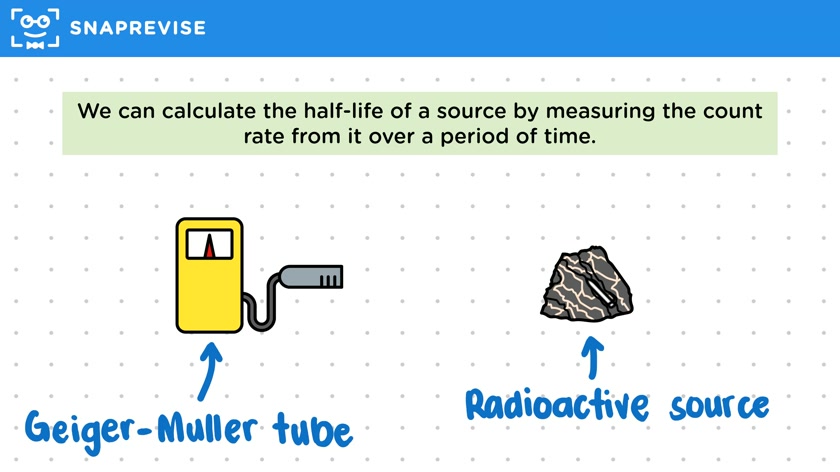
- To measure half-life, calculate the count rate over time using a Geiger-M��ller tube.
- The Geiger-M��ller tube detects radiation directed towards it, clicking for each decay.
- Measure count rate at even time intervals and plot on a graph.
- The graph shows a downward curve as count rate decreases over time.
- Half-life is determined by the time it takes for the count rate to halve from any value.
- Example: If count rate starts at 20, it halves to 10 in 1.5 minutes, then to 5 in 3 minutes, and to 2.5 in 4.5 minutes.
- The half-life of the sample is 1.5 minutes.
- Be confident in calculating half-lives from graphs for exams.
Please subscribe to access these revision notes.
This, and all other video notes, are included in our premium subscriptions.
Premium accounts get access to all videos and revision notes.
111
questions for Atomic structure
71
questions for Atoms and nuclear radiation