
GCSE Combined Science (AQA)
622 videos | 38 hours
Please subscribe to watch this video.
This, and all other videos, are included in our premium subscriptions.
Premium accounts get access to all videos.
Enable autoplay to keep watching
Your browser is blocking videos from playing automatically. To turn it back on:
Safari (Mac): Click the Safari menu item in the top bar, then Settings → Websites → Auto-Play, then set Auto-Play to Allow All Auto-Play for the current website.
Safari (iPhone/iPad): open the Settings app, then Apps → Safari → Auto-Play, and select Allow All Auto-Play.
Measuring Resistance
- Measure resistance by measuring current through and potential difference across a component.
- No device measures resistance directly; use current and potential difference measurements.
- Step 1: Set up the component in series with a cell using a simple circuit with one closed loop.
- Step 2: Connect an ammeter in series with the component; it measures the same current throughout the circuit.
- Ammeter should have low resistance to avoid changing the current.
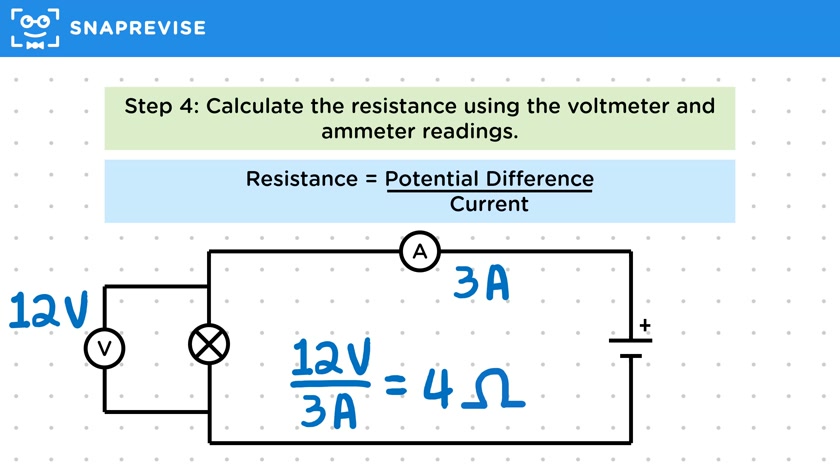
- Step 3: Connect a voltmeter in parallel with the component to measure potential difference.
- Voltmeter should have high resistance to prevent current splitting.
- Step 4: Calculate resistance using the formula: Resistance = Potential Difference / Current.
- Example: If current is 3 amperes and potential difference is 12 volts, resistance is 4 ohms.
- Step 5: Use a variable resistor to change current and potential difference, then calculate new resistance.
- Resistance changes with current; repeat measurements for different currents.
- Use a variable resistor in series to change total resistance and current.
- Record results in a table; resistance decreases with decreasing current.
- Repeat experiment for negative currents by reversing cell direction.
- Construct an IV graph using voltmeter and ammeter readings.
- Plot current on Y-axis and potential difference on X-axis.
- Different components produce different shaped graphs; understand how to plot an IV graph.
Please subscribe to access these revision notes.
This, and all other video notes, are included in our premium subscriptions.
Premium accounts get access to all videos and revision notes.
125
questions for Electricity
48
questions for Current, potential difference and resistance