
GCSE Combined Science (AQA)
622 videos | 38 hours
Please subscribe to watch this video.
This, and all other videos, are included in our premium subscriptions.
Premium accounts get access to all videos.
Enable autoplay to keep watching
Your browser is blocking videos from playing automatically. To turn it back on:
Safari (Mac): Click the Safari menu item in the top bar, then Settings → Websites → Auto-Play, then set Auto-Play to Allow All Auto-Play for the current website.
Safari (iPhone/iPad): open the Settings app, then Apps → Safari → Auto-Play, and select Allow All Auto-Play.
Measuring Speed of Sound - Oscilloscope
- An oscilloscope records and displays sound waves from connected microphones.
- Microphones detect sound waves and convert them to electrical signals.
- The oscilloscope displays wave patterns on a screen, showing wave properties.
- Wave patterns are shown on a centimeter square grid, representing sound waves.
- Sound waves are longitudinal, but the oscilloscope shows displacement over time.
- The x-axis on the oscilloscope represents time; each centimeter equals one millisecond.
- The distance between peaks on the display measures the period, not the wavelength.
- Oscilloscopes are used in GCSE to measure the speed of sound.
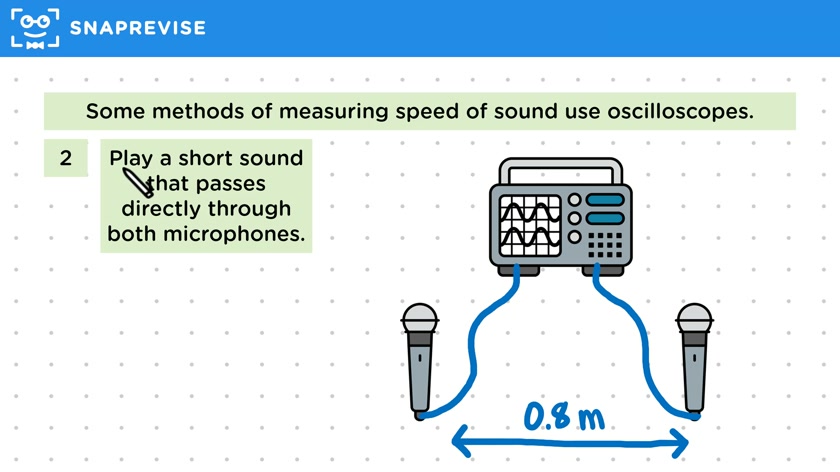
- To measure sound speed: connect two microphones to the oscilloscope and measure the distance between them.
- Play a short sound pulse through both microphones.
- Use the oscilloscope to determine the time difference between sound detection by each microphone.
- Adjust the timescale on the oscilloscope for clear signal visibility.
- Calculate wave speed using distance and time measurements.
- Example calculation: 0.8 meters distance, 2.5 milliseconds time, resulting in 320 meters per second speed of sound.
- Understanding oscilloscope readings is important for exam questions on measuring sound speed.
Please subscribe to access these revision notes.
This, and all other video notes, are included in our premium subscriptions.
Premium accounts get access to all videos and revision notes.
82
questions for Waves
38
questions for Waves in air, fluids and solids